Key takeaways
- Bronk and Collins argue the US should pre-emptively strike Hezbollah and Houthi anti-ship missiles before they kill American sailors or damage or sink US ships.
- Hezbollah’s Russian-built P-800 Oniks, possibly from a 2010 allotment to Syria, flies at up to Mach 2.6 with a range of up to 200km in export variants.
- The only anti-ship missile strike on a US Navy ship, against USS Stark in 1987, killed 37 sailors; the P-800 is four Exocets’ size and twice as fast.
- Iranian-backed proxies made nearly 60 reported attacks on American forces in Iraq and Syria within weeks, an escalation the authors compare to the run-up to the 1983 Beirut bombing.
- Losing a US warship in the Middle East would, the authors argue, weaken the US position in Asia and embolden China’s anti-ship weapons deployments in the South China Sea.
Christopher Bronk, Ph.D. and Gabriel Collins, J.D.
Suggested Citation: Christopher Bronk, Ph.D. and Gabriel Collins, J.D., “It’s Time for the US to Take Out Hezbollah and Houthi Anti-Ship Missiles,” National Security Note #1, 5 December 2023, collinsresearchportal.com
Violent non-state groups have spilled much American blood in the Middle East over the past four decades. The Beirut Barracks Bombing in 1983, the USS Cole attack in 2000, and Iran-backed insurgents in Iraq from 2004-2011 all inflicted tragedy. Now, our forces face a threat with even greater global consequences: advanced anti-ship missiles. American forces now find themselves deploying en masse near (and sometimes within) these lethal systems’ engagement envelopes.
Importantly, we know that violent non-state actors are willing to attack warships with these missiles. On the evening of July 16, 2006, a single missile–likely an Iranian Noor–flying about five meters above the water, struck the Sa’ar 5-class corvette INS Hanit as she conducted naval interdiction operations near Lebanon’s coast while Israel waged war against Hezbollah. The missile killed four Israeli sailors, but in an ironic twist, the same deck crane whose radar return helped attract the missile to the ship also absorbed most of the 165kg warhead’s explosive energy. This saved her from greater casualties and damage, and she returned to port under her own power. Hanit and her crew were lucky in this respect. The Cambodian-flagged, Egyptian-owned freighter, MV Moonlight was hit by a similar missile on the same evening as Hanit and eventually sank. Attacks by similar missiles sank the HMS Sheffield in 1982 during the Falklands War and crippled the USS Stark in the Persian Gulf in 1987.
Now imagine a similar scenario off Lebanon (or in the Red Sea) but instead of an Israeli corvette, the victim was a US Navy guided missile cruiser, destroyer, or aircraft carrier. And imagine that instead of an Iranian-made Noor missile that weighs less than a Smart Car hitting the ship at subsonic speed, the inbound projectile is a Russian-made P-800 Oniks that comes in high supersonic and weighs more than a Ford Raptor.
The threat is not hypothetical. Hezbollah leader Hassan Nasrallah recently “warned Washington…his group had something in store for the U.S. vessels deployed to the region.” This has been interpreted as Nasrallah brandishing Hezbollah’s Russian-built P-800 Oniks (known also by its export name, Yakhont) supersonic surface-to-surface missiles, which may have come from an allotment supplied to Syria in 2010. The P-800 represents a potentially grave threat to the large number of US naval units now on station in the Eastern Mediterranean.
Oniks is successor to the late Cold War-era P-700 Granit (NATO codename SS-N-19 Shipwreck), a missile that struck fear in the US Navy upon its deployment aboard Soviet submarines and surface ships in the 1980s. It is among the fastest cruise missiles currently deployed, with a top speed of Mach 2.6 and a range of up to 200km for export variants and considerably more for those deployed by Russia’s armed forces. Ukraine has faced the Oniks in attacks on Odesa and other littoral land targets. Ukraine’s air force spokesman stated of Oniks that, “It is difficult to fight with such missiles, but you can influence them in the end through electronic warfare.”
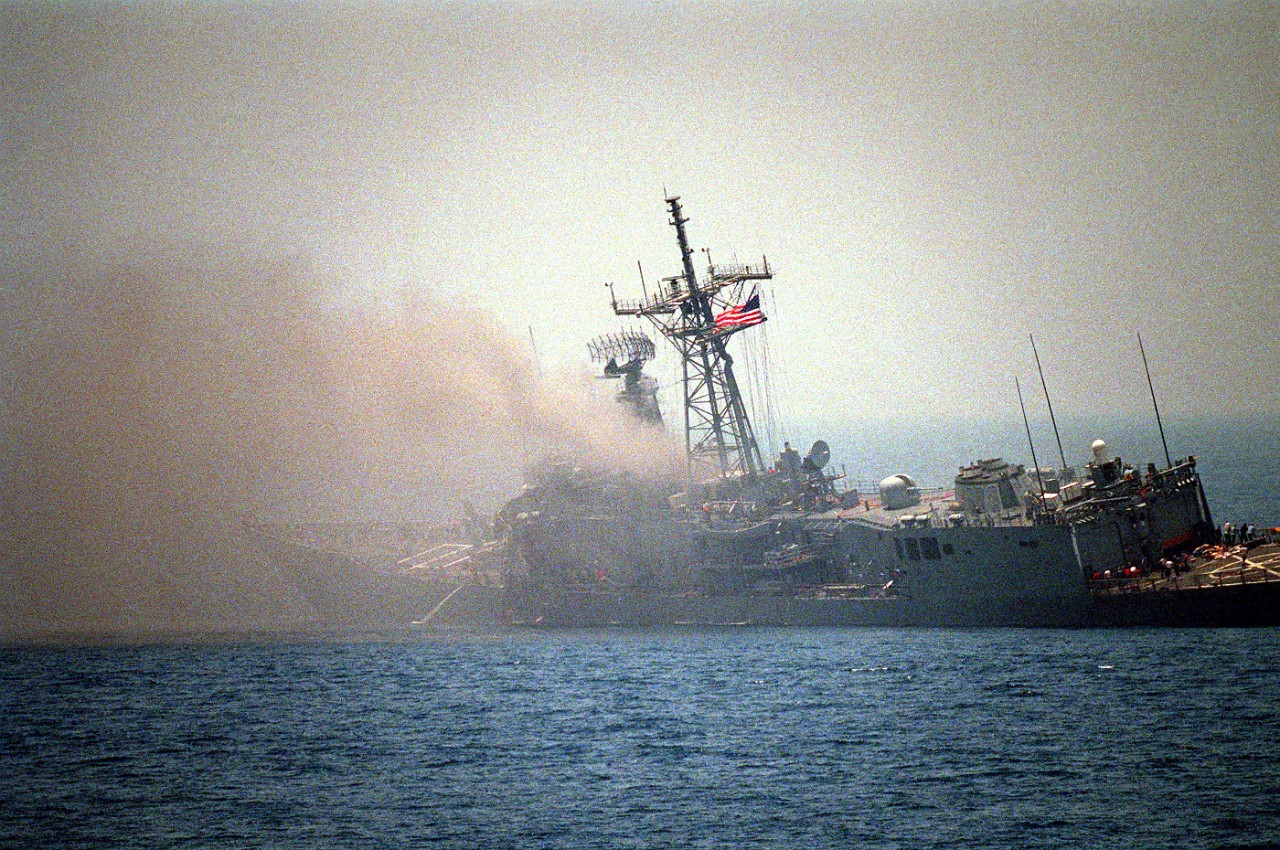
Only once have anti-ship missiles struck a US Navy ship–the USS Stark in 1987, where two Exocets killed 37 sailors, nearly sank the ship, and put it out of commission for over a year. The P-800 is the size of four Exocets and flies twice as fast. Such a strike would be catastrophic. And the loss it could inflict on US naval forces in the Middle East would impact the strategic balance in Asia physically through destroying/sidelining a key combat asset (or assets) and morally, by emboldening the PRC and affirming its decision to station similar types of weapons on the bases it has built throughout the South China Sea. Conversely, US pre-emptive strikes on Hezbollah and Houthi anti-ship assets would not only neutralize an acute threat, they would also send a strong message to Beijing, Moscow, Tehran, and others that the US will not tolerate revisionist actors’ threats to our men and women afloat.
Now is the time to send such a message. Since the attack on INS Hanit in 2006—the first case to our knowledge of a violent non-state actor successfully employing an anti-ship cruise missile—the threat has grown. Hezbollah has leveraged Syrian and Iranian assistance to amass stockpiles of increasingly advanced anti-ship missiles. Iran, in turn, has benefitted from Chinese and North Korean assistance and is very likely the source of anti-ship missiles proliferated to Yemen’s Houthi militants. The Houthis have used their anti-ship missiles, attacking the destroyer USS Mason and amphibious transport dock USS Ponce in 2016. The US Navy responded with Tomahawk missile strikes against three Houthi radar sites.
Iranian-backed proxies’ actions against American troops continue to escalate, with nearly 60 reported attacks against American forces in Iraq and Syria in the last few weeks. Some of these have come close to inflicting new tragedy. On October 26, an Iranian-backed militia launched a drone which struck a US barracks at the Erbil, Iraq. Fortunately, “the device laden with explosives failed to detonate and…only one service member suffered a concussion from the impact”, said the officials, who asked to remain anonymous to speak freely about the attack. The U.S. was lucky, they added, as the drone could have caused carnage had it exploded.” In early November, a US Reaper drone was shot down by Houthi air defenses off the coast of Yemen, a country over which such craft flew regular reconnaissance and strike sorties with only one prior reported shootdown.
The current steady drumbeat of escalation echoes aspects of the run-up to Hezbollah’s 1983 truck bomb attack that killed 241 Marines in Beirut. Dave Madaras, deployed to Beirut as a 22 year-old Marine recently told Reuters “We had rocket attacks, mortar attacks, before we got hit with the big bomb…Does history repeat itself?” American policymakers have the power to turn the direction of history. But it means making one of three choices, each with distinct complications. Option 1 is to withdraw from the region, Option 2 is to continue the current “small stick” defensive posture embodied by recent US airstrikes on virtually empty weapons storehouses in Syria, and Option 3 is to lean forward and send a robust message by striking Iranian proxies’ dangerous anti-ship assets before they can kill American sailors and damage/sink ships with them.
Israel could conceivably target these weapons systems independently, as it has done with hundreds of strikes on high-threat Iranian weapons shipments in recent years. But the proportional threat is far higher to the US given the global call on an increasingly short-handed US Navy. We cannot afford the loss of ships or people at this critical time of a Russia on the warpath and a “Decade of Maximum Danger” with China. Against that backdrop, the risks associated with pre-emptive strikes against Hezbollah and Houthi anti-ship missile batteries and facilitating equipment should come into focus as worth taking.
Anti-ship weapons that threaten maritime stability in the Eastern Mediterranean and Red Sea should be targeted. Standoff air strikes, cyber operations, or even direct action by special operations teams would be options available to the Biden Administration. US forbearance will likely be perceived as weakness, a position supported by the rising crescendo of attacks by Iranian proxies on American forces in the region. In contrast, use of force against Iranian proxy groups (and IRGC advisors that might accompany them) projects robustness that over time will rest deterrence on a firmer foundation and enhance prospects for lasting regional peace and stability. Furthermore, these actions’ congruence with America’s longstanding commitment to upholding Israel’s security can help create space for accelerating real political negotiations to resolve the challenges in Gaza and the West Bank—the only sustainable long-term path to peace.
These long-term benefits will create near-term risks. Hostilities will likely flare with Hezbollah and the Houthis. US forces will likely have to conduct strikes that injure or kill IRGC and Syrian forces supporting Tehran’s proxies and possibly even members of Russia’s Wagner Group given its regional activities. Upfront risks notwithstanding, the price of inaction would likely be higher. The United States can act against the Iranian regime’s program of regional maritime destabilization now or after an incident involving a large loss of life and potentially, scarce ships. Better to get ahead of the problem and remove the most advanced anti-ship weapons fielded by Iranian proxies as soon as possible. As Ukraine’s news service said after Odesa was hit by ground launched Oniks missiles, “Ukraine’s most reasonable option is to destroy these launchers.” The US should do the same to those in the hands of Hezbollah and the Houthis.
Frequently asked questions
What anti-ship missiles does Hezbollah have?
Hezbollah is believed to hold Russian-built P-800 Oniks supersonic missiles, also known by the export name Yakhont, which may have come from an allotment supplied to Syria in 2010. The Oniks has a top speed of Mach 2.6 and a range of up to 200km for export variants, making it among the fastest cruise missiles currently deployed.
Have the Houthis attacked US Navy ships with missiles?
Yes. In 2016 the Houthis used anti-ship missiles against the destroyer USS Mason and the amphibious transport dock USS Ponce. The US Navy responded with Tomahawk missile strikes against three Houthi radar sites. According to Bronk and Collins, Iran is very likely the source of the anti-ship missiles proliferated to the Houthis in Yemen.
Has a non-state group ever hit a warship with an anti-ship missile?
Yes. On July 16, 2006, a missile, likely an Iranian Noor, struck the Israeli corvette INS Hanit off Lebanon during Israel’s war with Hezbollah, killing four sailors. The authors call it the first known case of a violent non-state actor successfully using an anti-ship cruise missile. The freighter MV Moonlight was hit the same evening and sank.
What are the US options against Hezbollah and Houthi anti-ship missiles?
The authors outline three choices: withdraw from the region, continue the current “small stick” defensive posture, or pre-emptively strike Iranian proxies’ anti-ship assets. They favor the third option, citing standoff air strikes, cyber operations, or direct action by special operations teams as tools available to the Biden Administration.
What are the risks of US strikes on Hezbollah and Houthi missiles?
The authors acknowledge that hostilities with Hezbollah and the Houthis would likely flare, and US strikes could injure or kill IRGC and Syrian forces, and possibly Wagner Group members. They judge the price of inaction likely higher, because waiting could mean acting only after a large loss of life and of scarce ships.



Leave a Reply