Game manager quarterbacks will have to learn the “no huddle” offense
Syndicated from Gabriel Collins, “Electricity Powers National Security—Can America’s Grid Meet the Moment?,” The Sinews of Civilization, Substack, 2 November 2026, https://gabrielcollins.substack.com/p/electricity-powers-national-security
What is the most underappreciated physical enabler of national power? These days, electricity sits near the top of the list.
When it’s abundant and reliable, climate control works, factories hum, and water systems flow. When it’s not, things go south in a worst case and stay stuck in a better case, meaning we fall behind if we fail to produce and deliver electrons while our chief global competitor (China) can.
Electricity helps determine national power because it is such a ubiquitous input and tool for doing work. The aluminum housing of the iPhone or Microsoft Surface you might be reading this on is essentially congealed electricity. The comfortable space you’re sitting in requires electricity to remain cool—and in many places, to stay warm. The coffee you may be sipping is largely made of water that was cleaned and delivered by a big dollop of electrons. And those are just a few examples.
Electricity is perhaps the one commodity input that is even more pervasive than oil in modern life. Mass electrification is arguably among the three most transformative inventions of the past 200 years, trailing only widespread vaccination and the Green Revolution as a positive transformer of human lives.
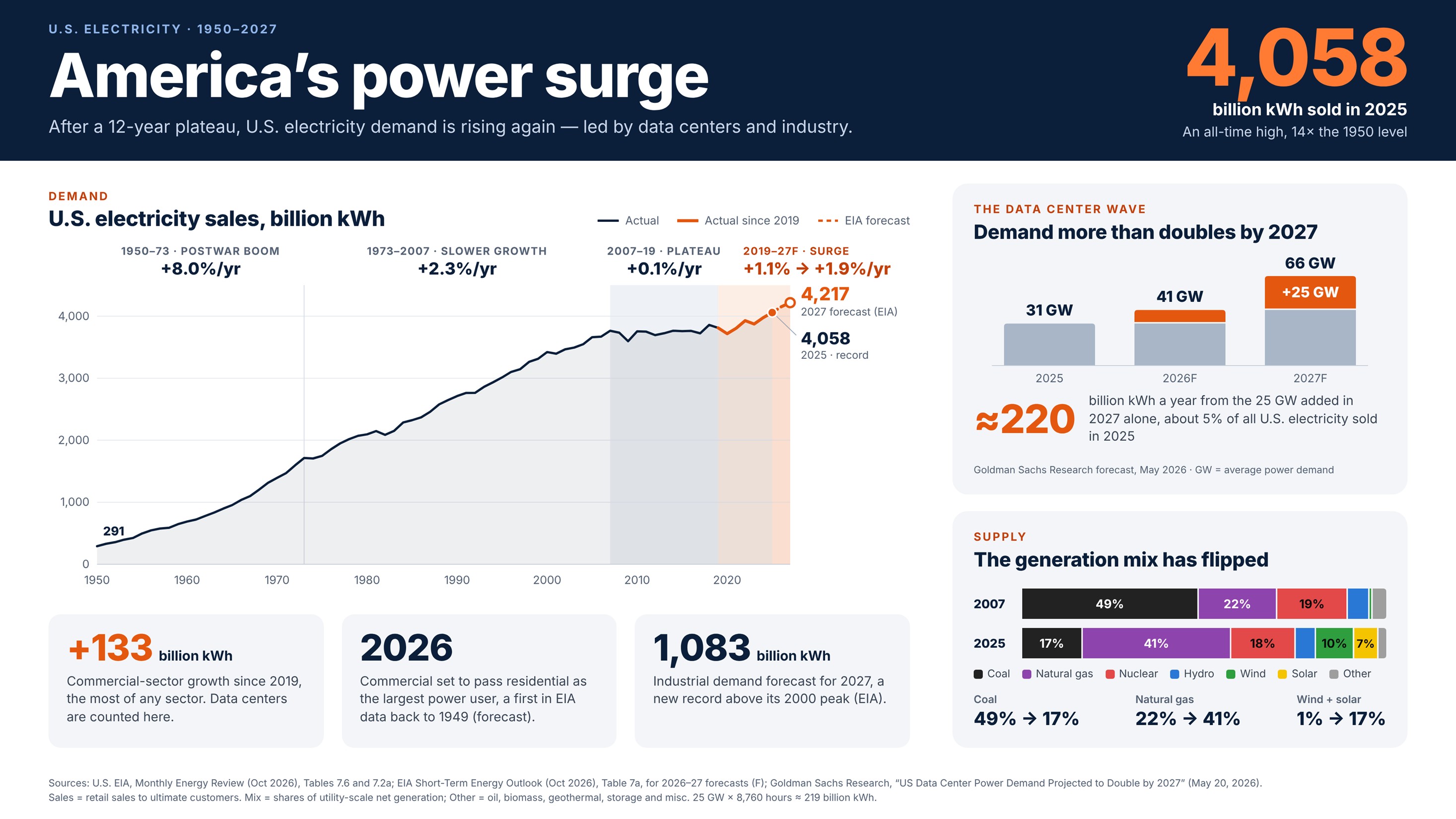
Electricity is also a proxy for a society’s ability to do big things. Can it mobilize capital, install equipment at epic scale, and marshal the political will to do this for years on end? That described the United States during the Cold War and it described the People’s Republic of China for the past 25 years. American electricity use rose by 8% a year on average from 1950 to 1973. In the wake of massive energy shocks, the average annual growth rate then slowed to 2.3% for the next 34 years. From 2007-2019, electricity use basically remained flat. After 2019, it started to grow again.

Source: EIA, Author’s Analysis
We now live in interesting electricity times. More people are moving to the hottest parts of the U.S. There is a bipartisan push to revive manufacturing. Datacenters are cropping up. All of this requires large quantities of electricity. And it happens in a new era of global energy price volatility and at exceptional speed and scale.
Freeport LNG—the largest single electricity load in CenterPoint’s Houston service area (nearly 650 MW) required about a decade between the commencement of permitting and full plant operations.[i] A 650 MW-class datacenter could realistically be brought online three times faster.
If the 25 gigawatts of datacenter capacity that Goldman Sachs believes will come online in 2026 and 2027 manifests and those facilities run at 85% utilization, that alone would be a demand increase equivalent to about 5% of present U.S. total electricity use. U.S. utilities are scrambling to meet this nearly unprecedented combination of velocity and scale.[ii]
The present generation of senior management has spent most of their careers in a low to no electricity demand growth environment. After learning to be “game managers,” they are now being asked to run a “no huddle offense.” As my good friend Alex Robart points out in a great series of recent LinkedIn posts, this dynamic alone poses an incredible array of risks and opportunities.
America’s power surge is here—are we ready to plug in and launch a new period of grid work to meet the moment? This is going to be a recurring theme and we’ll come back to its various subdomains frequently in coming months and years.

[i] Freeport LNG, “Corporate History,” accessed November 1, 2026, https://freeportlng.com/about/corporate-history.
[ii] Gabriel Collins, “Are Data Centers Just Another Industrial Asset?,” Collins Research Portal, August 28, 2026, https://collinsresearchportal.com/2026/08/28/are-data-centers-just-another-industrial-asset/.

Leave a Reply