The Midterms will reshape where the next wave of compute gets built.
Syndicated from: Gabriel Collins, J.D., “Datacenter Ranching: Why the Blue Wave Will Push Hyperscale Compute Into the Permian Basin,” The Sinews of Civilization, Substack, 16 November 2026. https://gabrielcollins.substack.com/p/datacenter-ranching-why-the-blue
In the November 3 Midterms, it looked a lot like datacenters lost big on ballots across the United States. Yet there is a key reality of prior infrastructure and commodity booms that is likely to be repeated in the datacenter rush as well: assets tend to be concentrated where the preconditions are best and they are most politically welcome.
That is why the US Shale Boom exploded in a handful of basins 15 years ago despite many other areas detesting fracking and even banning it. It is also why we are likely to see the US continue adding major datacenter capacity despite rising political opposition.
The Blue Wave will wash more opportunities into places like the Permian Basin, the focus of this analysis. Hence the idea of “datacenter ranching.”
Let’s put some numbers to what has the potential to become a world-leading AI development fairway. If we assume a very rough rule of thumb under which each gigawatt of computing capacity requires 1,500 acres of land, the US could double its present datacenter compute capacity using about 60,000 acres of land. There are single ranches in the Permian with more land than that. The entire Basin spans more than 55 million acres.
That does not mean all of this potential gets realized. Rather, it suggests that even if the vast majority of the United States–and even major parts of Texas–remain politically hostile to datacenters–there is still lots of space to build into. The Permian is a full stack energy opportunity with flat land, abundant gas, bright sun, strong wind, and eventually, space for nuclear reactors.[1]
It is also a region with a century of experience with major industrial development. This conditions community expectations in ways that are generally far more conducive for development than is the case for places seeing giga-scale cement, steel, and electrons for the first time.
Private Ownership–And the Associated Economic Incentives–Are The Key Unlock
The Permian AI opportunity layercake shares its most powerful unlock with the Shale Boom that preceded the current rush: private land ownership. Private ownership of land and associated rights transmutes industrial development from a burden into a financial opportunity.
Hosting datacenters will be particularly attractive for large landowners who tend to live off tract and who will, in many cases, be highly receptive to multi-year revenue opportunities that are insulated from the commodity price volatility that afflicted their pre-existing oil & gas income streams.
In plain English, oil and gas royalty revenues can swing 2-fold in a single year whereas a long-term datacenter siting agreement provides a steadier, inflation-indexed cash flow that also incorporates multiple secondary monetization opportunities such as water sales, disposal, solar and battery siting, and other activities.
For these reasons, even if suburban voters distrust datacenters, the large rural landowners with the best hosting characteristics will in many cases welcome them. Unless the political environment shifts radically, that is where investment is going to head. The Permian has had multiple oil & gas booms and now it is likely to undergo a multi-decade compute and electricity boom.[2]
So what do those numbers look like?
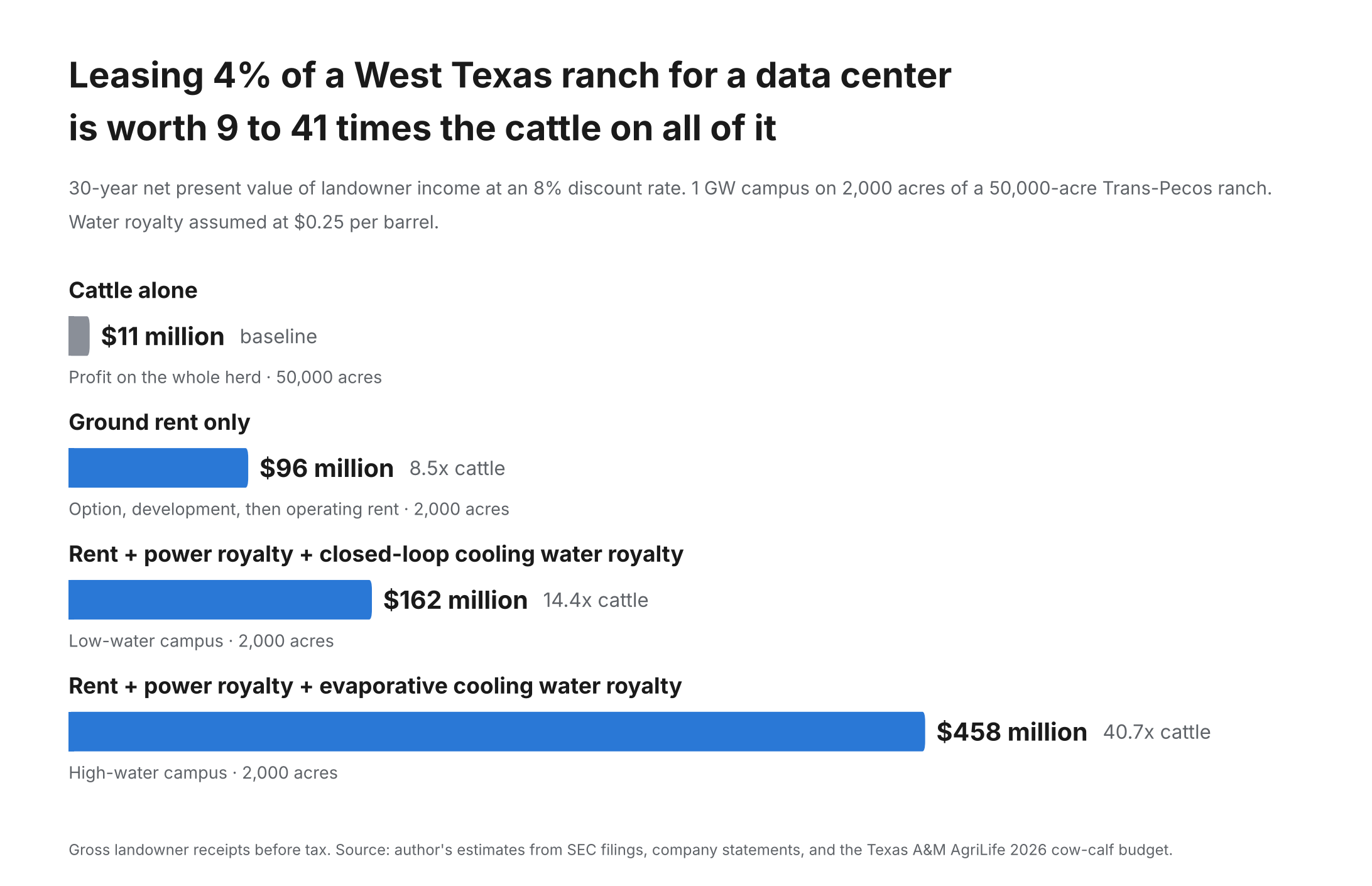
Our hypothetical ranch is 50,000 acres in area. It currently runs cattle and has a decent groundwater supply. With a gas pipeline spur, the owner could also carve out 2,000 acres on one corner to host a 1 GW AI complex plus the associated gas-fired power generation capacity and batteries needed to supply behind-the-meter electricity.
The table below lays out the basic economics of how that could plausibly look on a 30-year net present value basis. It assumes an 8% discount rate, current cattle raising returns from the Texas A&M Extension budget, and datacenter leasing terms available from disclosures by LandBridge and Fermi.
The bottom line is that compute yields returns cattle never could (14X, to be specific). Compute leasing also stacks directly on top of the “frac ranching” model that Permian surface owners have already built around caliche sales, pipeline easements, frac-water sourcing, and produced water disposal.[3] Unlike drilling and completion cycles—where surface water sales and pad fees spike during active development and taper off—a 2,000-acre compute complex locks in a permanent, utility-like baseload of surface revenue while leaving the rest of the ranch fully open for oilfield and livestock operations.
Reality is of course complex, because there are likely all manner of other economic activities going on already on tracts of this size. Furthermore, not every landowner will want a datacenter. Money is a powerful force, but far from the only factor that drives human decision-making. We mind our wallets (usually) but are also emotive beings.
With those cautions in mind, the economic profile of datacenter leasing is compelling enough that a sizable portion of major Permian landowners will likely seriously entertain the idea. If even one-quarter of landowners in the Permian Basin were willing to host hyperscale computing facilities, that would already unlock a globally-transformational quantity of compute.

My model is designed to be illustrative and while it is rooted in the best publicly available data I can find, readers may have better information. As such, I am making the full model available for download here in case any of you would like to test my assumptions or add what could very well be better ones from your own knowledge:

Data Center Ranching Model Npv30 V2
30.7KB ∙ XLSX file
I’d love to hear your thoughts and critiques.
How Can Newly Elected Texas Officials Translate Permian AI Competitiveness Into Policy?
- Special Compute Corridors: Embrace the fact that even if much of Texas voted “no” or “slow” on datacenters, the smaller number of pro-development counties in places like the Permian actually want the facilities. Concretely, this could take the form of a policy that encourages the TCEQ and other state-level permit issuers to apply standards evenly, but expedite the process in places where county officials and residents are actively asking for facilities to be sited. If a community is giving social license, the state should respect that. Local control facilitates sustainable industrialization.[4]
- Protect the Scarcest Resources: In Texas, it is much easier to make more electrons than it is to make more water. Furthermore, as the simple economic model above shows, private landowners could actually have adverse incentives that lead them to favor less water-efficient cooling approaches that create larger water sales opportunities. This would concentrate financial gains at the expense of aquifer conditions that impact other people far beyond a given ranch’s borders. As such, permitting should favor projects that are using low-water designs and which, to the extent that they need water, are sourcing it from non-potable sources with the lowest possible direct connectivity to surface water bodies such as lakes, rivers, and springs.
- Push for Hyperscalers to participate in public-private partnerships: The Permian Strategic Partnership offers a superb example of a public-private facilitation structure that can help municipalities and regions manage the impacts that major industrial development can have on roads, schools, and in the case of datacenters, water and power systems. While the “resource curse” concept is typically associated with mining or oil & gas development, highly concentrated datacenter development in more rural parts of Texas (and elsewhere in the US) could have similar impacts.[5]
Conclusion
Texas voters have spoken clearly–datacenters have become a big enough industrial enterprise that they need guardrails and need to ask for social license to operate. As Governor-elect Hinojosa and a broad panel of new agency officials and legislators prepare to take office in January, they will inherit a situation that until this election cycle, was largely managed on autopilot.
Now that voters have made clear that datacenters are an issue they care about intensely, the new Administration will need to more proactively mitigate risk while also facilitating development. It is a balancing act that will require diversified power sourcing, safeguarding aquifer sustainability, rapid and clear permitting decisions, and a deep commitment to remaining open for business. This will require being consistently transparent with communities.[6] It will also require us to tailor state-level policy to match local conditions and demands.
What we accomplish in the Permian Basin, as well as other high-potential pockets of Texas over the next 24 months will establish policy leadership that scales far beyond our Lone Star borders.
Suggested Citation: Gabriel Collins, J.D., “Datacenter Ranching: Why the Blue Wave Will Push Hyperscale Compute Into the Permian Basin,” The Sinews of Civilization, Substack, 16 November 2026.
Please share this post with your friends!
Disclosure Note: I serve as a strategic advisor to Revive Water Resources, LLC.
[1] https://www.bakerinstitute.org/sites/default/files/2025-08/20250815-Permian%20Basin-WP_0.pdf
[2] As someone born in Midland and raised there and Artesia, NM, I do have biases. But on an objective level, the Permian Basin has advantages few other places on the planet do as locations for hosting large-scale AI compute.
[3] Gabriel Collins, Frac Ranching vs. Cattle Ranching: Exploring the Economic Motivations Behind Operator-Surface Owner Conflicts over Produced Water Recycling Projects, Issue Brief no. 10.17.17 (Houston: Rice University’s Baker Institute for Public Policy, October 17, 2017), https://www.bakerinstitute.org/sites/default/files/2017-10/import/BI-Brief-101717-CES_Ranching.pdf
[4] Gabriel Collins, “Local Dynamism Is the Engine of American Renewal,” The Sinews of Civilization: Fire, Food, Water, Force (Substack), January 29, 2026, https://gabrielcollins.substack.com/p/local-control-the-exit-strategy-for
[5] Gabriel Collins, Has Unconventional Oil & Gas Development in the Texas Permian Basin Created a Subnational Resource Curse?, working paper (Houston: Rice University’s Baker Institute for Public Policy, May 20, 2021), https://hdl.handle.net/1911/114718.
[6] Gabriel Collins, “The Data Center Industry Needs Its Own FracFocus-Style Transparency Initiative,” The Sinews of Civilization: Fire, Food, Water, Force (Substack), July 2, 2026, https://gabrielcollins.substack.com/p/data-centers-fracfocus-transparency-computefocus

Leave a Reply