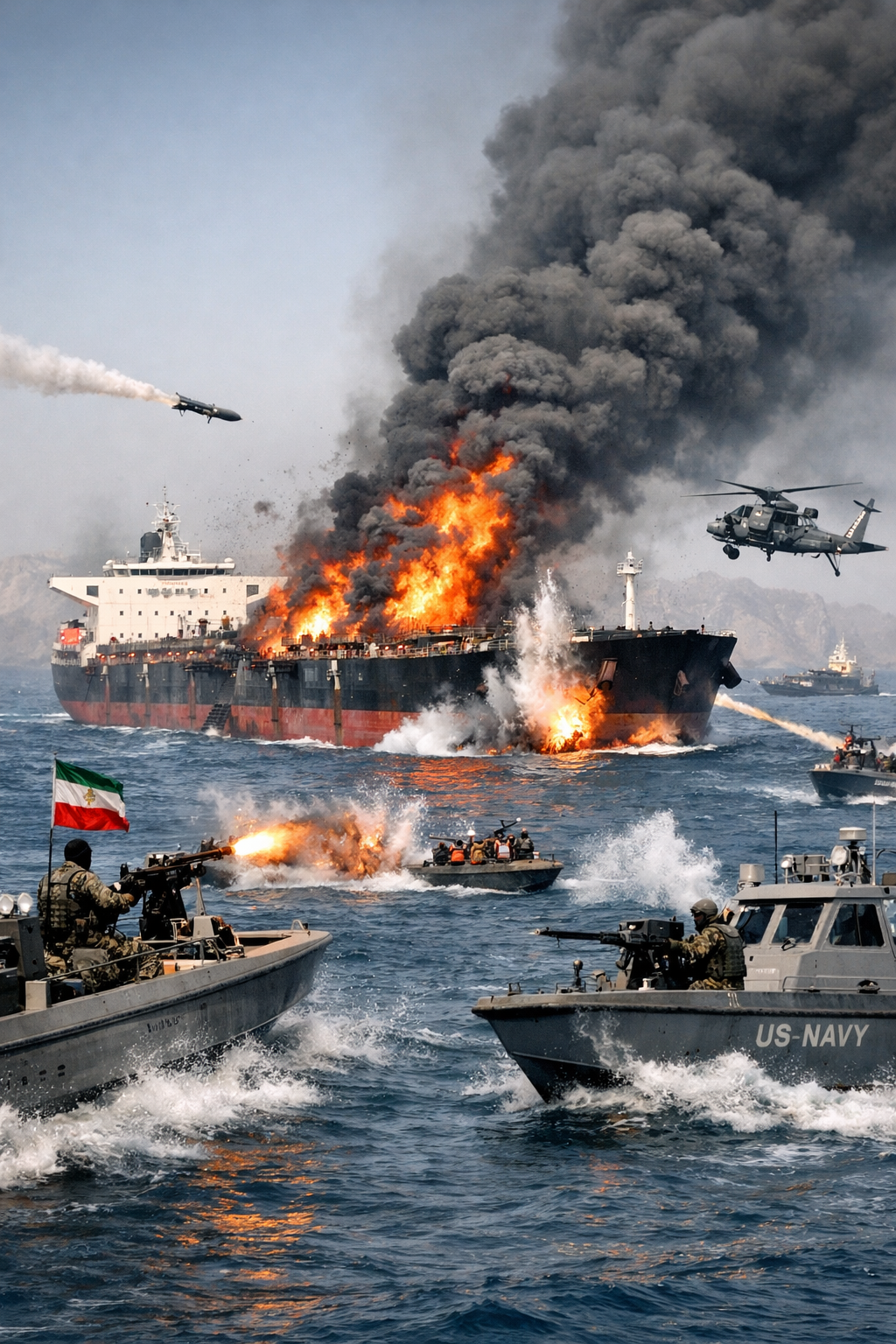
The Iran War is very likely creating a multi-year oil and gas transport security monster. Solutions will be expensive.
The Strait of Hormuz has quietly stoked anxiety amongst oil folks ever since the 1979 Iranian Revolution. During the 1980s, the Tanker Wars amped up the fear level but the shooting, mines, and kinetic action remained in the northern Gulf and Hormuz stayed open.
If your tanker could sail the first few hundred miles without getting hit by a missile or running into a mine, the Strait was open and the barrels onboard made it onto the market. That’s why oil prices didn’t move much. In fact, they were low during much of that era—epitomized by a 1980s Texas bumper sticker that read “Please God, give me one more oil boom. I promise not to piss it away.”
This time is different. In prior crises, the question was whether the Strait would close. Now, the question is how often and how cheaply it can be contested.
The US and Israeli decision to launch a war on Iran has turned hypothetical fear into lived reality. Daily tanker transits through Hormuz have plummeted from about 60 per day into the single digits. Somewhere between 10 and 12 million barrels per day of oil production are now unavailable to the market. Oil futures markets are pricing several months of disruption to come.
Yet even that seemingly pessimistic view is likely underselling the new risk level. What is emerging is not a temporary disruption, but a persistent system in which Iran can repeatedly contest the Strait at low cost and high strategic leverage. The Strait is now continuously contestable strategic terrain—one that will absorb money, platforms, attention, and likely lives.
Iran’s IRGC and military have now arguably become a supersized, nation-state version of the Houthis. The Houthi comparison is not about Iranian state sponsorship of the Houthis, but rather, about a set of harsh realities this piece argues are not yet fully priced into global oil markets. Here are two core traits the IRGC and Iranian military share with the Houthis when it comes to threatening seaborne energy shipments.
Common Trait #1: Capitalizing on Geography
They geographically command a vital global maritime passage and by all indications thus far, intend to make full use of that leverage.
Common Trait #2: Asymmetric Warfare
Short range ballistic missiles that cost several hundred thousand to a few million dollars apiece, anti-ship missiles costing several hundred thousand dollars apiece, and air and sea drones that cost tens of thousands apiece can command a waterway that carries well over a billion dollars in commerce per day.
The logic is simple: strike one ship and the insurance companies will halt the next 100. Unless Iran’s regime falls AND a more pro-Western successor emerges, repeated Strait crises will likely become the default path for years to come.
Suppressing these asymmetric activities requires a war effort with a minimum of dozens of aircraft, a hundred or more ships, and other supporting platforms. That is a cost in money, munitions, focus, and human energy that the US will struggle to sustain across global theaters.
Furthermore, US military stretch means that many platforms and people needed for missions like a Strait clearance are often not based full time in the Middle East. We have brought the kitchen sink of capabilities to bear. A large subset of these are not forward based in CENTCOM but instead rotate from hotspot to maintenance to training and back to the next hotspot.

The rotational dimension gives our opponents strategic optionality. Building up the means to clear a contested waterway can take weeks—as we see right now. This means that whatever regime emerges from this war in Iran (unless we get very lucky) can throttle crisis up and down to strain, stretch, and manipulate. The Houthis do it, North Korea does it, and very likely, Iran will now do it.
In that respect, this war is likely to increase entropy in the energy markets and add another risk factor that can swing from front to tail at the whim of those in Tehran. They will have manipulation dominance and, in many ways, escalation dominance as well. If you like volatility, this new world’s for you.
How long will this challenge persist?
Readers might be skeptical hearing such a view right now, when Iran has absorbed more than 16,000 US and Israeli strikes. While Iran is on its back foot now, prudence mandates that we assume they will adapt and rebuild capabilities. Iran has a significant domestic industrial base. Much of it is damaged or destroyed at the moment. But so was Ukraine’s in 2022 and 2023 and look at that country’s domestic weapons production now.
Over the next week or so, we’ll likely see the lowest ebb of Iran’s ability to contest the Strait (and even now ship traffic is at a virtual standstill). Once the heaviest shooting stops—whether tomorrow, three weeks from now, or some point later—Iran will begin rearming. The cycle then begins again. It may not be an Iraq or Afghanistan-style boots on the ground Forever War, but it’s likely to become a periodic major maritime security affliction that flares up when it is convenient for Tehran.
Roughly 2.5 years after the Houthi attacks on shipping began, ship transits through the Bab al-Mandeb are still not much more than half their pre-event level.

The Strait of Hormuz is different than the Red Sea chokepoints because a shipowner cannot just divert around the Cape of Good Hope. Yet the threat is likely to be persistent. So what comes next? The following probabilities reflect current military positioning, political constraints, and historical precedent from prior maritime security operations.
The Next 6 Months
Near-Term Outcome #1: Strait Opened in 2-4 Weeks Through a Massive Military Operation (50% probability)
A full-scale Strait of Hormuz tanker escort operation would be the largest naval escort mission in over 80 years. Only the World War II Battle of the Atlantic convoy operations required greater naval and air warfare capacity. But today, we contemplate this mission with a Navy that is a fraction of its World War II or Cold War fleet size — and facing an enemy armed with asymmetric weapons operating on its home geography.
Near-Term Outcome #2: US “Declares Victory” and Pulls Back (35% probability)
This is the outcome most feared by the Gulf States because it leaves them at Iran’s mercy.
A “cut and run” would leave the Strait under de facto Iranian control because the Gulf states by themselves lack the capability to militarily re-open it. It would also open the possibility of Iran taxing energy shipments in order to ensure safe passage. This could be a very tempting option. For perspective, the Panama Canal generates nearly $6 billion/year in transit fees.
Near Term Outcome #3: Strait Opened Via Deal With Iran (10% probability)
For such a deal to be politically acceptable to the US, Iran would have to pull back militarily and affirm that the Strait is legally an international waterway with rights of free passage. The US would have to give something meaningful in return, perhaps reparations payments. This is a much less likely outcome because after twice being struck during active negotiations, Iran will be extremely distrustful of the US government.
It is also very unlikely that Iran would want to concede whatever it has retained in spite of war, be that influence over Strait transit, enriched uranium, or missile and drone programs.
Beyond 6 Months
Medium-Term Outcome #1: Oil Exporters Build Additional Alternative Routing Options
Prior Gulf crises have prompted pipeline construction to the Red Sea. More such projects are likely. I am now drafting a much deeper report looking at the history of these projects—such as the Saudi East-West Pipeline. In that paper to come, we’ll delve into financial projections and geopolitical assessments of potential future export diversification options.
Medium-Term Outcome #2: LNG Contract terms Change, US Projects Look More Attractive
Oil exporters can find alternative routing options. For gas exporters (i.e. Qatar) that is a much bigger challenge. It is likely that future projects will have to discount their gas relative to antebellum levels to attract buyers, who are now amply aware that the risk of Strait closure is very real. US gas looks relatively more attractive since it is not subject to maritime chokepoint risk.
For China, taking additional Russian pipeline gas at a scale that at least partially offsets current Qatari contracting may become more attractive.
Conclusion
Operation Epic Fury has unleashed a set of furies all its own. Iran’s newly exercised hard power leverage over the Strait of Hormuz and transit in much of the Persian Gulf is a new enterprise feature. It’s not yet clear how many dollars per barrel this will translate into over time, but a material geopolitical risk premium seems almost inevitable until more alternatives routes come online. That is probably a 5-year process.
Leverage cannot be undiscovered. And it cannot be bombed away. This is how a maritime security Forever War quietly starts and endures for the remainder of the Oil Age.
Suggested Citation: Gabriel Collins, “Houthis on Steroids: The Rise of Persistent Maritime Contestation,” The Sinews of Civilization, Substack, 20 March 2026. https://gabrielcollins.substack.com/p/houthis-on-steroids-the-rise-of-persistent



Leave a Reply