Key takeaways
- Russia’s oil production decline will weaken Moscow’s ability to project power over time but may raise the risk of aggression within the next five years.
- Khanty-Mansisk, which produces about 40% of Russia’s oil, saw output fall more than 13% from 2019 to 2024, while the rest of Russia declined 4%.
- Russian drilling is at levels not seen since the late 1980s and horizontal wells rose from about 15% in 2011 to about 70%, yet production still declines.
- Russia produces roughly 10 million barrels per day, 11% of global supply in 2024, earning approximately US$120 billion in oil revenues that year.
- Sanctions limit Russia’s access to technology and capital, and the Vostok Oil project could cost $130 billion to reach a theoretical 2 million barrels per day.
Falling production will weaken it over time—but first, it may push the Kremlin toward faster, riskier action.
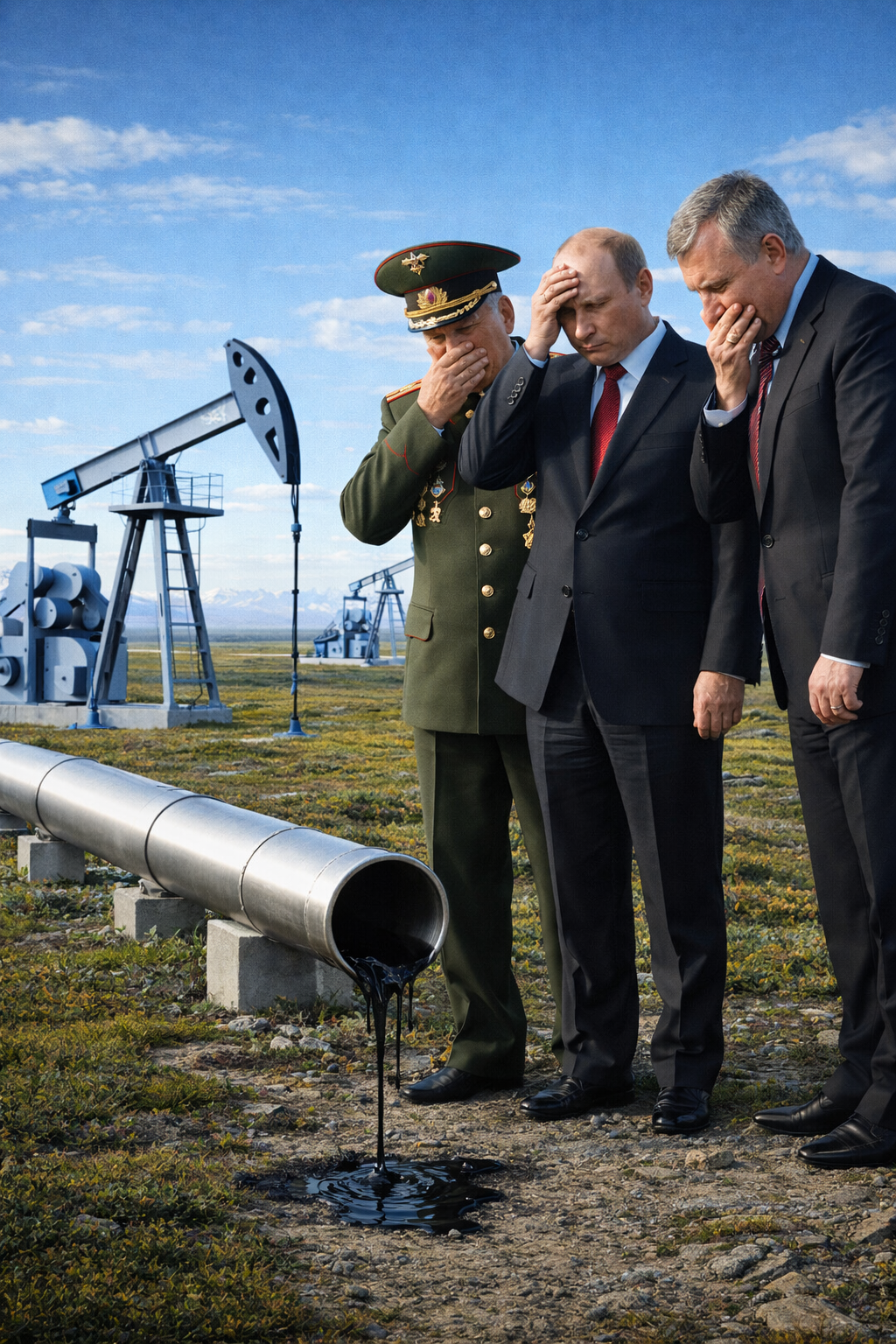
Russia’s era of easy oil from Western Siberia is ending. This creates a fiscal constraint Moscow cannot bomb or propagandize away. Over time, this will weaken Russia’s ability to project power. In the next five years, however, it may have the opposite effect—raising the risk of aggression as the Kremlin moves before its advantages erode further.
The battle against geological decline—which is difficult and expensive to fight—does not capture the same attention as the shooting war in Ukraine. Operations in Siberian, Volga, Caspian, and Arctic oilfields lack the viral video impact of combat. But barrels from those fields (or the lack thereof) will drive Russia’s strategic decision-making, military capacity, and global influence.
As the rector of the Almetysk State Technology University “Higher School of Oil” put it in a March 2025 interview[GC1] : “Yes, the era of easy oil is over…There will be no more ‘gushers.” This is a problem for Russia because while “infinite money is the sinews of war,” the Kremlin’s domestic and foreign financing efforts inexorably boil down to either the direct sale of oil or its indirect monetization through “loans for oil” deals.
Therefore, oil production is perhaps the most critical metric for assessing Russia’s capacity to exert international influence, maintain its war effort, and rebuild for possible future conquests in the remainder of Ukraine, Poland, the Baltic States, and potentially, Central Asia.
Why Oil Matters So Much
Russia produces roughly 10 million barrels per day of oil (11% of global supply in 2024) with a population less than half that of the United States and an economy[GC2] about 15% smaller than Texas’s[GC3] . As such, it has a large portion left over for export, which makes it a systemically important supplier with commensurate income (approximately US$120 billion in oil revenues[GC4] in 2024) and geopolitical influence.
Influence flows from the fact that oil pervades modern life. It remains the world’s most widely traded commodity, with an annual global turnover exceeding US$2 trillion at an average price of $60 per barrel—more than three times the value of all semiconductors sold worldwide in 2024[GC5] .
Oil is also highly fungible. After Russian tanks crossed into Ukraine in February 2022, Urals oil that would have been sold to European buyers was easily re-directed to China, India, and other alternative markets.
Steep discounts driven by reputational and sanctions risks made the oil even more attractive to customers in the Global South, although the same buyers continue lifting cargoes to this day even as the discount to global benchmark crude grades narrows. In short, if Russian producers can get barrels to a port or an export pipeline, a buyer will pay for them. But the trend suggests there will be fewer barrels in coming years.

The War Beneath
Geological fatigue is real in the Russian oil patch. Despite strenuous efforts, Russia’s oil production is faltering. Oil producers are drilling at levels not seen since the late 1980s. Furthermore, the proportion of horizontal wells—used to access more of an oil-bearing formation from a single wellbore—has risen from about 15% in 2011 to approximately 70% today. Yet oil production still declines.
Russia is transitioning from a resource superpower to a resource depletion manager. In Russia’s oil heartland of Khanty-Mansisk in Western Siberia, which accounts for approximately 40% of the country’s output, production has steadily declined since 2009. From 2019 to 2024 alone, output in Khanty-Mansisk fell by more than 13% while the rest of Russia also saw oil production decline by 4%. Russian companies have had some exploration successes in Eastern Siberia and the Caspian Sea area, but not on a scale sufficient to overcome declining fields in Western Siberia.
Could declines be reversed? Oil production is typically a product of the function Geology X Technology X Capital X Oil Prices = Output. Russia still has significant geological potential—as attested to by at least one large American oil company’s secret talks with Russian state campion producer Rosneft that the Wall Street Journal [GC6] reported on in August 2025. Oil prices are largely beyond its control.
That leaves technology and capital. For Russia, access to technology and capital are functions of geopolitics. Behave like a normal country and they are readily available, invade neighbors, and they disappear. Western sanctions have progressively crimped access to both as Moscow devolved from seizing Crimea in 2014, to sponsoring a lethal shadow war in Eastern Ukraine from 2014-2022, to launching the full-scale invasion in 2022 and the nearly 4-year major war that continues to rage.
A. Capital
Capital enables drilling at the scale and pace needed to arrest production declines. In the first decade of the Shale Boom, U.S. producers spent over $1 trillion in capital investment. If one assumes oilfield services spending equals 2/3 of total CAPEX—roughly the ratio for Russia—the data suggest North American oil & gas producers annually spend roughly 6 times what Russian ones do in USD terms. Even accounting for the attenuating impacts of ruble-devaluation on local service costs in Russia, the gap is still substantial.
Russian oil producers’ ability to self-fund investments are likely to be limited. Russian official disclosures of fully-burdened oil production costs suggest that the “margin” left over once operating, capital, and other costs are paid for is on the order of 30-to-40%. Wartime financial stresses plus the cost of repairing damage caused by Ukrainian strikes on refineries and other infrastructure plausibly bring the gross margin on exported oil and refined products closer to 25%.
With annual crude oil and product exports earning around $120 billion in gross revenues and assuming the Russian government allowed companies 10% returns, perhaps $18 billion per year in additional funds could be freed up for reinvestment in future production. Companies like Lukoil and Rosneft that are being forced by sanctions to divest assets outside Russia might also be able to invest additional money in domestic operations as a result.
Taken together, these factors could potentially double existing capital investment levels. Companies could also accept Chinese loans or even equity investments, but in doing so would simply deepen Russia’s position as a resource vassal of Beijing. Even with more money, the empirical lesson of recent years is that simply drilling more holes and putting more steel in the ground has failed to revive oil production in Russia.
B. Technology
Technology matters too. It amplifies the impact of the capital deployed, especially when older fields and more complex deposits are involved—precisely the situation Russian producers now face in Western Siberia. In a virtuous circle, technology’s ability to increase returns on capital in turn stimulates investment in developing and improving the technologies deployed for drilling and production. This is why a leading American drilling company like H&P can by itself drill in a year about 70% of the footage all the producers and drillers in Russia achieved, but with only 1/7 as many rigs[GC7] .
Technology is vital onshore, but is especially irreplaceable in the extremely challenging Arctic offshore projects the Kremlin thinks can offset Western Siberian production declines. The Vostok Oil project, located over 1,700 miles northeast of Moscow, could in theory produce 2 million barrels per day of oil at peak output[GC8] . But it could also cost $130 billion to develop. Could Moscow self-fund developing the project to its full potential? Maybe, but not likely.
That matters because foreign capital is not riding to the rescue. Even if the war in Ukraine ends, many companies may hesitate to invest given that Russia could start another war, expropriate assets or forcibly impose new fiscal terms once foreign investors sank their capital investment in. All have happened in the past 20 years.
Finally, any potential Russian oil production asset (assuming a durable ceasefire in Ukraine) would be portfolio competed against other assets around the world. Oil deposits in Argentina, Guyana, Iraq, Gulf producers, and other options in the Americas—would all generally present better “above ground” risk profiles than those located in an aggrieved, imperialistic Russia.
The End of Easy Oil
Declining Russian oil output will impact China, European NATO members, India, the U.S., Canada, and most of all, Russia’s post-Soviet neighbors.
For China and India, a Russia whose best oil days are behind it will appear a less attractive partner. For Canada, every Russian barrel that does not materialize is an additional market space for heavier, high-sulfur crude from the Alberta oilsands. For the U.S. and European NATO members, a Russia with less oil revenue over time remains a persistent threat, but a structurally declining one with less ability over time to pay for military hardware and the soldiers to man it.
For Russia’s post-Soviet neighbors, this means a heightened period of danger in the next 5 years if Russian leaders conclude their window for action is closing. But it also means that a successful deterrence campaign to hold the line for the next decade would very likely culminate in a Moscow that remains embittered but with substantially less capacity to translate territorial ruminations into tanks crossing borders.
Conclusion
We should not underestimate Russian resolve. Oil underpins Putin’s domestic survival and Russia’s global position. Drilling activity attaining or even surpassing Soviet-era records in the next 3 years is entirely foreseeable. Higher oil prices could also provide temporary respite. Finally, Russia has other resources—gas, metals, coal, nuclear fuel sales, and arms—but even combined they cannot equal what oil earns. And its arms sales potential has been badly dented by the Ukraine War, where a range of NATO and Ukrainian indigenous weapons have handily outperformed Russian-made systems.
In the near term, the financial pressure may make Russia more dangerous, not less—compressing the window in which it can still most readily convert resource wealth into military power. Over time, however, the constraint will bite. The easy oil is depleting fast. The remaining barrels are harder and more expensive to produce. And the financial foundation of Russian power will erode with them.
Russia will not run out of oil. But it will run short of the cheap oil that has underwritten its last 18 years of military adventurism.
Suggested Citation: Gabriel Collins, “Russia’s Oil Production Decline Is a Geopolitical Clock,” The Sinews of Civilization, Substack, 9 April 2026. https://gabrielcollins.substack.com/p/russias-oil-production-decline-is
Thanks for reading The Sinews of Civilization: Fire, Food, Water, Force! Subscribe for free to receive new posts and support my work.
[GC1]Dyakonov, Alexander. “‘Fontanov bolʹshe ne budet.’ Kak dobyvatʹ trudnoizvlekaemye zapasy nefti” [“‘There Will Be No More Gushers.’ How to Produce Hard-to-Recover Oil Reserves”]. RIA Novosti – Sotsialʹnyy Navigator, March 18, 2025. https://sn.ria.ru/20250318/neft-2005480399.html
[GC2]https://www.reuters.com/markets/europe/russia-raises-2024-gdp-growth-figure-43-2025-04-11/
[GC3]https://apps.bea.gov/itable/?ReqID=70&step=1#eyJhcHBpZCI6NzAsInN0ZXBzIjpbMSwyOSwyNSwzMSwyNiwyNywzMF0sImRhdGEiOltbIlRhYmxlSWQiLCI1MzEiXSxbIk1ham9yX0FyZWEiLCIwIl0sWyJTdGF0ZSIsWyIwIl1dLFsiQXJlYSIsWyI0ODAwMCJdXSxbIlN0YXRpc3RpYyIsWyIzIl1dLFsiVW5pdF9vZl9tZWFzdXJlIiwiTGV2ZWxzIl0sWyJZZWFyIixbIjIwMjQiXV0sWyJZZWFyQmVnaW4iLCItMSJdLFsiWWVhcl9FbmQiLCItMSJdXX0=
[GC4]Source: https://www.oxfordenergy.org/wpcms/wp-content/uploads/2025/02/Comment-Fiscal-Flex.pdf
[GC5]Source: https://www.semiconductors.org/global-semiconductor-sales-increase-19-1-in-2024-double-digit-growth-projected-in-2025/
[GC6]https://www.wsj.com/business/energy-oil/exxon-rosneft-russia-oil-talks-f524e81f
[GC7]Sources: *Rosneft. “Проходка «РН-Юганскнефтегаза» достигла 7 млн метров горных пород” [Drilling by RN-Yuganskneftegaz Reaches 7 Million Meters of Rock]. Rosneft. Accessed May 27, 2025. https://wwwˌrosneftˌru/press/news/item/222079/, https://www.helmerichpayne.com/media/general/HP_2023_Sustainability_Report.pdf, NGV, ROGTEC, Author’s Analysis
[GC8]https://2021-2025.state.gov/office-of-the-spokesperson/releases/2025/01/sanctions-to-degrade-russias-energy-sector
Frequently asked questions
Is Russia’s oil production declining?
Yes. Gabriel Collins argues Russia’s oil production is faltering despite strenuous efforts. In Khanty-Mansisk, the Western Siberian heartland that accounts for about 40% of national output, production has declined steadily since 2009 and fell more than 13% from 2019 to 2024. Output in the rest of Russia declined by 4% over the same period.
Why can’t Russia reverse its oil production decline?
Russia lacks sufficient capital and technology, and Western sanctions have progressively restricted access to both. Collins estimates North American producers spend roughly 6 times what Russian ones do each year in USD terms. Recent experience also shows that drilling more wells and putting more steel in the ground has failed to revive Russian output.
Does falling oil output make Russia more or less dangerous?
Both, depending on the timeframe. Collins expects a heightened period of danger over the next 5 years if Russian leaders conclude their window for action is closing. Over the longer term, less oil revenue means less ability to pay for military hardware and soldiers, so a decade of successful deterrence would very likely leave Moscow far less capable.
How much money does Russia earn from oil?
Russia earned approximately US$120 billion in oil revenues in 2024, according to figures cited in the article. The country produces roughly 10 million barrels per day, about 11% of global supply. Collins notes that gas, metals, coal, nuclear fuel sales and arms combined cannot equal what oil earns for Moscow.
What is Russia’s Vostok Oil project?
Vostok Oil is an Arctic project located over 1,700 miles northeast of Moscow that the Kremlin hopes can offset Western Siberian declines. It could in theory produce 2 million barrels per day at peak output but could cost $130 billion to develop. Collins judges that Moscow funding it alone is possible but not likely.


Leave a Reply