Key takeaways
- The Taiwan denial options aim to close invasion routes into Taiwan’s ports and landing beaches with mines, missiles, loitering munitions, drone boats, and beach obstacles.
- Collins proposes sending Taiwan 250 of the roughly 500 M109A6 guns the U.S. has in storage, plus 2,000 Excalibur or PGK-M-equipped shells per gun.
- For 50-to-250 km ranges, the options include six dozen HIMARS launchers, more GMLRS and ATACMS rounds, ground-launched Small Diameter Bombs, and hundreds more AGM-84 missiles.
- Taiwan could pre-position old bulk carriers near key port approaches for scuttling, and Panamax bulkers can be chartered for about $5.5 million annually.
- Civil defense options call for 60 days of hardened, dispersed liquid fuel stocks and arms caches with 1 million small arms and 20,000 anti-tank weapons.
Full Infographic Downloadable Here.
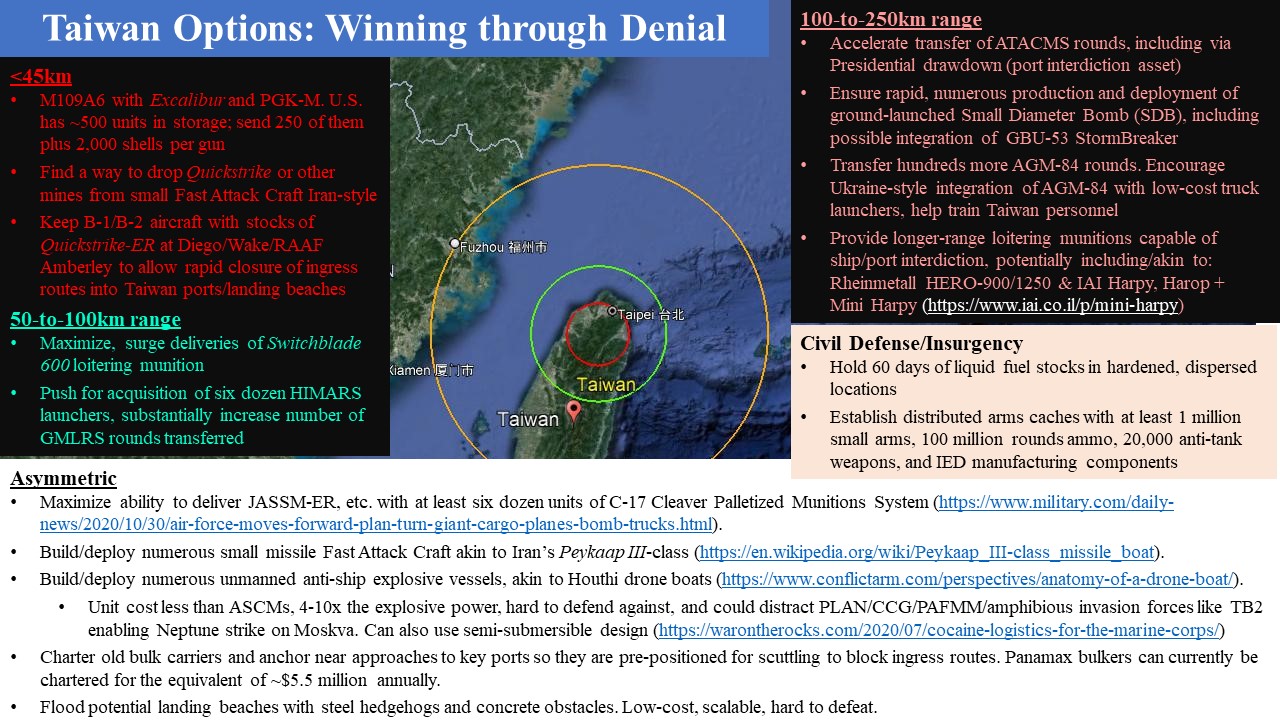
Ranges <45km
•M109A6 with Excalibur and PGK-M. U.S. has ~500 units in storage; send 250 of them plus 2,000 shells per gun
•Find a way to drop Quickstrike or other mines from small Fast Attack Craft Iran-style
•Keep B-1/B-2 aircraft with stocks of Quickstrike-ER at Diego/Wake/RAAF Amberley to allow rapid closure of ingress routes into Taiwan ports/landing beaches
50-to-100km range
•Maximize, surge deliveries of Switchblade 600 loitering munition
•Push for acquisition of six dozen HIMARS launchers, substantially increase number of GMLRS rounds transferred
100-to-250km range
•Accelerate transfer of ATACMS rounds, including via Presidential drawdown (port interdiction asset)
•Ensure rapid, numerous production and deployment of ground-launched Small Diameter Bomb (SDB), including possible integration of GBU-53 StormBreaker
•Transfer hundreds more AGM-84 rounds. Encourage Ukraine-style integration of AGM-84 with low-cost truck launchers, help train Taiwan personnel
•Provide longer-range loitering munitions capable of ship/port interdiction, potentially including/akin to: Rheinmetall HERO-900/1250 & IAI Harpy, Harop + Mini Harpy (https://www.iai.co.il/p/mini-harpy)
Asymmetric
•Maximize ability to deliver JASSM-ER, etc. with at least six dozen units of C-17 Cleaver Palletized Munitions System (https://www.military.com/daily-news/2020/10/30/air-force-moves-forward-plan-turn-giant-cargo-planes-bomb-trucks.html).
•Build/deploy numerous small missile Fast Attack Craft akin to Iran’s Peykaap III-class (https://en.wikipedia.org/wiki/Peykaap_III-class_missile_boat).
•Build/deploy numerous unmanned anti-ship explosive vessels, akin to Houthi drone boats (https://www.conflictarm.com/perspectives/anatomy-of-a-drone-boat/).
•Unit cost less than ASCMs, 4-10x the explosive power, hard to defend against, and could distract PLAN/CCG/PAFMM/amphibious invasion forces like TB2 enabling Neptune strike on Moskva. Can also use semi-submersible design (https://warontherocks.com/2020/07/cocaine-logistics-for-the-marine-corps/)
•Charter old bulk carriers and anchor near approaches to key ports so they are pre-positioned for scuttling to block ingress routes. Panamax bulkers can currently be chartered for the equivalent of ~$5.5 million annually.
•Flood potential landing beaches with steel hedgehogs and concrete obstacles. Low-cost, scalable, hard to defeat.
Civil Defense/Insurgency
•Hold 60 days of liquid fuel stocks in hardened, dispersed locations
•Establish distributed arms caches with at least 1 million small arms, 100 million rounds ammo, 20,000 anti-tank weapons, and IED manufacturing components
Frequently asked questions
What does a denial strategy for Taiwan mean?
A denial strategy aims to prevent PRC invasion forces from successfully achieving lodgment on Taiwan. The options Collins lists focus on mining ingress routes, striking ships and ports at ranges up to 250km, obstructing beaches, and preparing civil defense and insurgency capacity.
What weapons could the U.S. quickly send to Taiwan?
The list includes M109A6 howitzers with Excalibur and PGK-M shells, Switchblade 600 loitering munitions, six dozen HIMARS launchers with more GMLRS rounds, ATACMS via Presidential drawdown, ground-launched Small Diameter Bombs, and hundreds more AGM-84 missiles. Collins suggests sending 250 of the roughly 500 M109A6 units in U.S. storage.
How could drone boats help Taiwan against a Chinese invasion?
Unmanned explosive boats, akin to Houthi drone boats, could strike or distract Chinese naval and amphibious forces at low cost. Collins notes they cost less per unit than anti-ship cruise missiles, carry 4-10x the explosive power, and are hard to defend against, much as TB2 drones helped enable the Neptune strike on Moskva.
How could Taiwan block its own ports during an invasion?
Taiwan could charter old bulk carriers and anchor them near the approaches to key ports, ready to be scuttled to block ingress routes. Collins notes that Panamax bulkers can currently be chartered for the equivalent of ~$5.5 million annually, making this a relatively low-cost denial measure.
What civil defense measures are proposed for Taiwan?
Collins proposes holding 60 days of liquid fuel stocks in hardened, dispersed locations. He also recommends distributed arms caches with at least 1 million small arms, 100 million rounds of ammunition, 20,000 anti-tank weapons, and IED manufacturing components to support civil defense and insurgency after any landing.



Leave a Reply