Full Presentation–Download Here
Please cite as: Gabriel Collins, “Global Energy Transition in the 2020s: Managing Externalities Takes Center Stage,” EarthxEnergy: Responsible Energy Acquisition Conference, 23 October 2020, Houston, TX
Overview
In this October 2020 keynote at the EarthxEnergy conference in Houston, Gabriel Collins argues that the world has been in an energy transition for 200 years and that the next phase will be slower and bumpier than hoped, because legacy, scale, cost and reliability govern energy systems. He expects deeper electrification and new forms of energy geopolitics, since low-carbon sources front-load critical materials, and warns that retiring baseload power in favor of intermittent supply invites blackouts and price spikes. China, India and the United States used 46.3% of the world’s primary energy in 2019 and drove 65% of demand growth from 2010 to 2019, and China added as much coal-fired capacity in 2019 as the U.S. did in four to five years of its 1960–1985 buildout. He estimates that every 10% of U.S. gasoline demand displaced by EVs requires about 3% more power generation, and sees a growing role for nuclear energy.
Full text of the slides (from the PDF)
Slide 1. Gabriel Collins, J.D.
Baker Botts Fellow for Energy & Environmental Regulatory Affairs
Baker Institute for Public Policy, Rice University
Please cite as: Gabriel Collins, “Global Energy Transition in the 2020s: Managing Externalities Takes Center
Stage,” EarthxEnergy: Responsible Energy Acquisition Conference, 23 October 2020, Houston, TX
Global Energy Transition in the 2020s:
Managing Externalities Takes Center Stage
*Note: These are working research findings and are subject to change. In the event of material developments, the author will post an updated version.*
Slide 2. Disclaimer & Disclosure
This analysis reflects my personal opinions and assessments only. It is designed solely to be illustrative and stimulate broader thought, with the objective of elevating the conversation in the energy and water space. It IS NOT an investment analysis or investment advice. It is also NOT offering any legal opinions or advice and does not create an attorney-client relationship with any reader or consumer of the information presented herein. Readers rely on the information in this analysis at their own risk.
Neither the author nor the Baker Institute for Public Policy are liable for any loss or damage caused by a reader’s reliance on information contained in any of the charts, data series, opinions, or other information presented herein. I am not a hydrologist, geologist, or engineer and am not offering advice on technical aspects of any assets which may be discussed in this analysis, including, but not limited to geological factors and engineering challenges that may arise in an oilfield water development project. The information and opinions contained in, and expressed by this analysis, are based on sources deemed reliable. However, there is no warranty, assurance, or guarantee, express or implied, about the completeness, reliability, or accuracy of this content. The views expressed herein are my interpretations as of the date the report is published and are subject to change without notice.
Mr. Collins holds a membership interest in Cactus Water
Services, LLC. This relationship is covered by a Rice University conflict of interest management and monitoring plan.
Slide 3. Thinking About Global Energy Transition in the 2020s
We’ve been in an “energy transition” for the past 200 years, but…devices and systems that produce and consume energy are analog—change is already underway but will likely take longer than we want it to Energy geopolitics are not going anywhere—but we’ll experience them in some new forms because lowercarbon energy sources like renewables and nuclear tend to “upfront” the critical material inputs.
The world will likely continue on a path of greater electrification, given electricity’s local cleanliness at point of use and the fungibility of generation (i.e. an electric motor is the ultimate “multi-fuel” motor, capable of using electrons from coal, gas, oil, nuclear, wind, solar, hydro, and anything else able to spin a dyno).
Legacy matters, scale matters, cost matters (intimately related to the first two factors), and reliability matters
Retiring baseload energy sources in favor of intermittent generators is a deed very likely to result in punishment through blackouts, electricity price spikes, and unintended consequences such as greater private generator use and liquid fuel demand (think China 2004).
The most profound change will be accomplished at the local and national levels
It’s a bumpy road ahead with massive uncertainty—so let’s buckle up!
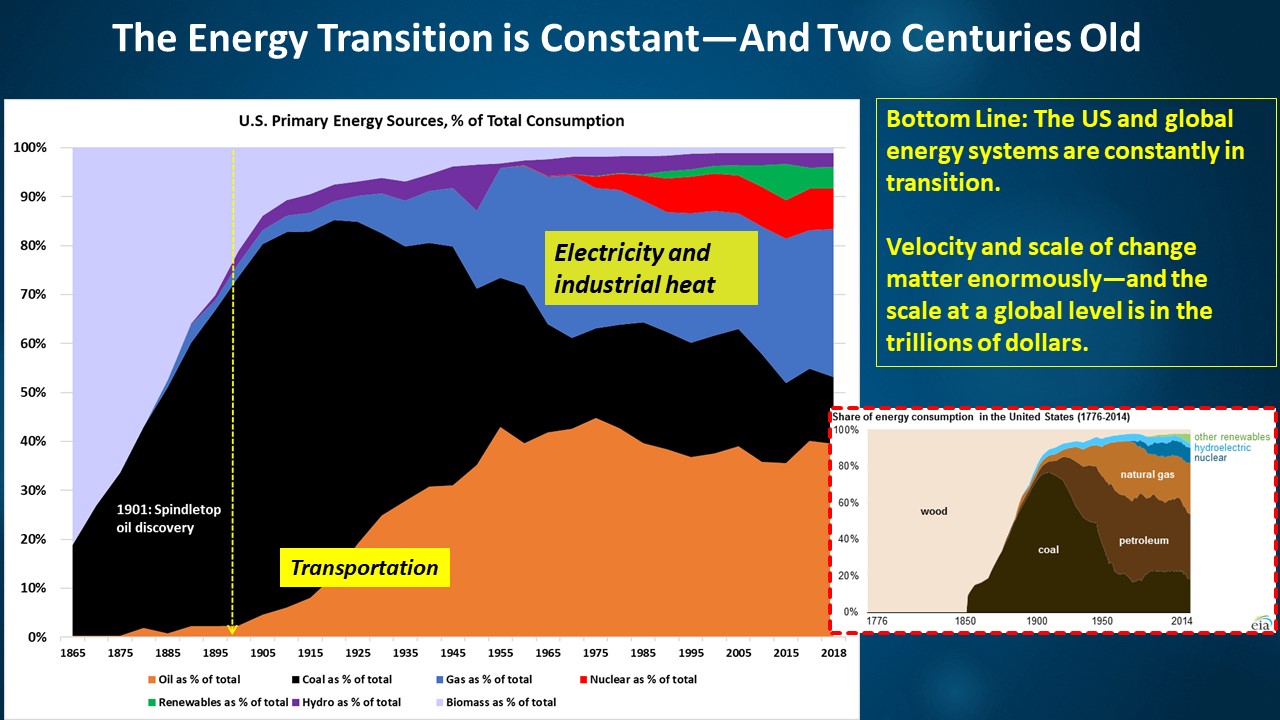
Slide 4. The Energy Transition is Constant—And Two Centuries Old
Bottom Line: The US and global energy systems are constantly in transition.
Velocity and scale of change matter enormously—and the scale at a global level is in the trillions of dollars.
Transportation
Electricity and industrial heat
Slide 5. How We Think About Energy: Aspirations And Priorities
Controllable, convenient energy availability is a very recent phenomenon.
“The fifty million Americans who dwelt in what F. Scott
Fitzgerald called ‘that vast obscurity beyond the city’ still moved between birth and death to the ancient rhythms of sun and season. More than forty-five million of them had no indoor plumbing in 1930 and almost none had electricity. They relieved themselves in chamber pots and outdoor latrines, cooked and heated with wood stoves, and lit their smoky houses with oil lamps.”—David M. Kennedy, Freedom From Fear: The American People in Depression and War, 1929-1945. (16)
What factors are various populations most acutely sensitive to when it comes to producing and using energy?
Affordability, accessibility, reliability. Other things?
How do these various groups think about externalities? https://mx.depositphotos.com/103848718/stock-illustration-caveman-discoveringfire.html
Preferences and priorities that govern our actions involuntarily illustrate the central importance of legacy, scale, and incremental evolution rather than disruptive revolution of local, national, and global energy ecosystems
Slide 6. Energy is a Force-Multiplier and a Liberator
Transportation Force Multiplier Liberation
Source: Houston Chronicle, Peterbilt
2-3 kW (2.6-3.9 HP)
373 kW (500 HP)
Vs.
Source: NPR, IWMI
15 miles/day
500+ miles/day
Slide 7. It’s Also a Lifesaver
A sample of more than 200 countries and territories analyzed by the author reveals a strong negative relationship between access to electricity and mortality from waterborne illnesses.
Sub-Saharan Africa—the world’s most broadly energy-poor region— also has the countries with the highest rates anywhere globally of death per capita from unsafe water.
Water for human consumption (as well as other uses) embeds an often underappreciated quantity of energy.
As an example, every 1,000 gallons of groundwater supplies used in the City of San Antonio embeds an estimated
12 kWh, nearly the energy storage capacity of a Tesla Powerwall (14 kWh).
Source: CIA World Factbook, Author’s AnalysisGabe Collins, “The Texas Energy and Water Nexus,”
Water Resources IMPACT, American Water
Resources Association, July 2019
Slide 8. Thinking About The Global Energy System: Having Your Burger and Eating It Too
Moving into 2020s: Certain groups want the “energy burger” without the “cow”
Energy Sourcing Reality now…
Extending the meat analogy, bridging this gap in the 2020s requires a multi-source mindset
Source: Shutterstock
Source: Wikipedia
Source: Motivar (Argentina)
Many dislike this part…
But you must have it to enjoy this part… at least not at transformational scale
Slide 9. Pulling Cows From The System Quickly: What Happens to the Meat Market?
California Electricity Generation By Source, GWh
Source: BatteryIndustrytech
“…California’s experience also underscores a growing consensus among energy scholars: that variable renewable energy technologies are unlikely to meet the grid’s power demand by themselves. They will play an important role, but more firm generating sources, like next-generation nuclear reactors, natural gas plants with carbon capture technologies, enhanced geothermal, and others that can balance out variable renewables, will be required.”—Alex Trembath and Zeke
Hausfather, Slate, 19 August 2020 [emphasis added]
California Blackouts
Source: California Energy Commission
Slide 10. The Digital Economy is Also Very Energy-Intensive
Apple’s Maiden, North Carolina Data Center Reportedly uses 100 MW of Electricity, Approximately The Same As an Arc
Furnace Capable of Producing 1.4 million Tonnes per Year of Steel.
World-scale data centers create electrical loads on par with large electric arc furnace steel mini mills
Slide 11. In Case The Prior Slide Didn’t Convince
You…Here is Large Data Center in Northern China With Its Own Adjacent
Power Plant
Slide 12. Energy Transitions: Global Perspective
Global Primary Energy Consumption by Source, Million Tonnes Oil Equivalent
Coal YoY
Change, Mtoe
Oil YoY
Change, Mtoe
Gas YoY
Change, Mtoe
Nuclear YoY
Change, Mtoe
Hydro YoY
Change, Mtoe
Renewables
YoY
Change, Mtoe
Source: BP Statistical Yearbook of World Energy
Slide 13. Don’t Over-Weight
Shocks: Structural
Change Generally Drives
Commodity Demand
Shifts
The coronavirus may turn out to be structurally transformation to certain segments of oil demand— such as jet fuel—by causing businesses to re-evaluate the prior mentality of “let’s get on the plane now and fly there.”
For other parts of the market—especially those levered to freight—the demand dent from lockdowns will likely be temporary.
Source: EIA, Author’s Analysis
Slide 14. Four Key Factors Influencing
Humanity’s Energy Sourcing and Use:
Legacy, Scale, Availability, Reliability
Slide 15. What Are “Legacy” and “Scale?”
“Legacy” in an energy setting refers to the installed base currently used to produce, process, distribute, and consume various energy sources. The sunk capital cost is in the trillions of dollars, with annual global maintenance requirements likely in the hundreds of billions annually. The phenomenal size of these investments, the ecosystems that have grown up around them, and the various constituencies with vested interests in their function—including consumers—makes change an incremental proposition. It’s tough to carve a new path.
“Scale” refers to the sheer size of these systems. Scale also provides the heft and relative efficiency from serving a large customer footprint—substituting a $500 million power plant and large transmission lines for an army of local generators that collectively cost more and require far more sustainment resources per unit of energy produced. Scale often facilitates delivery of services to a maximal number of consumers per unit of capital spent in building and maintaining the system.
Slide 16. Turnover
Arithmetic:
Electricity
Production
Installed Capacity Needed to Substitute for 5% of 2019 Electricity Production, GW
Source: BP Statistical Review 2020, Author’s Analysis (assuming 25% capacity factor for wind, 82% for nuclear)
• Key takeaway is that nuclear could make a lot of sense as a decarbonization tool that still ensures steady baseload power supplies. At current construction cost levels, the upfront capital costs of the installed capacities shown in the chart are roughly the same (between $800 and $850 billion).
• If modular reactors can be produced at scale, the capital costs could begin to more strongly favor nuclear.
• Factoring in costs of storage and other grid-stability measures further favors nuclear.
Slide 17. Scale: China, India, U.S. as The Global Energy Titans
Where these three go in the energy consumption and sourcing, so goes also the global emissions balance.
U.S. energy transition is primarily about substitution of the existing installed base.
China and India have to manage both substitution and deciding what sources will meet future energy demand growth.
All three must also make decisions amidst an incipient U.S.-China technology Cold War and rising tensions between China and both the U.S. and India across the diplomatic, economic, and military spectrum. Some potential outcomes of these conflicts may yield a more sustainable energy slate, others not so much.
Proportion of 2019 Global Total
Use
Proportion of Net Global
Demand Change Between
2010 and 2019
Primary Energy Consumption 46.3% 65.0%
Electricity Generation 49.9% 72.2%
CO2 Emissions 50.5% 64.2%
Oil/Liquids Demand 39.5% 64.1%
Coal Demand 70.7% 80.6%
Natural Gas Demand 30.9% 51.7%
Hydro Demand 40.3% 79.5%
Nuclear Demand 44.6% 1087.6%
Renewables Demand 47.2% 50.9%
Scaling: In energy unit terms, the world consumed 10X as much oil as it did renewables
Source: BP Statistical Review of World Energy 2020
Slide 18. China’s Energy
Supply: “All
Sources on Deck”
Future increasingly looks like
“clean” plus “coal”
Gas use likely to rise as well, particular with Power of Siberia (and possible subsequent pipelines) and deepening of Russia-China commodity sourcing relationship.
Nuclear share likely to begin rising substantially 2025 and beyond, especially if overall economic growth (and rate of energy consumption) were to substantially slow. Source: BP Statistical Review of World Energy 2020
Managing Substitution and Growth
Slide 19. Legacy Influenced by Local Resource Availability and Global Conditions
U.S. Coal and Gas-Fired Power Generation Capacity Additions China Coal-Fired Power Generation Capacity Additions
U.S. coal plant installed base now 40 years old (or more)
Shale gas abundance and favorable prices make gas-for-coal substitution economically and politically attractive
China added as much coal-fired generation in 2019 as U.S. would have in 4-5 years during its 1960-1985 buildout.
Source: EIA, Author’s Analysis Source: EndCoal, Author’s Analysis
The U.S. example also shows how unexpected macro events can accelerate decoupling from legacy burdens.
Slide 20. The “Innovation Gospel” Versus Legacy and Scale
• “Innovation” and “energy transition” are two of the presently most overused—and misused—words in the English language
• The ability to leverage pre-existing supply chains and human capital turbocharge energy system change as well.
• Here we have “sexy” and “scalable.” To change the world, we also need “sustainable.” Both below examples will be challenged…
Energy Innovation: “Sexy” Example Energy Innovation: “Scalable” Example
Source: Elektrek
Source: EIA, Houston Chronicle, Author’s Analysis
Tesla rightfully evokes images of high-tech, but the unconventional oil & gas boom also floats atop a raft of proprietary technical innovations.
Slide 21. Legacy and Scale Also
Mean That The Pace of Transition to New Energy
Sources and The Level of Financial Risk in These
Operations Will Likely Be Closely Tied to Market
Dynamics of Systemically
Important Legacy Fuels, Especially Crude Oil, For Years to Come Image Source: NPR
Slide 22. Oil is “Sticky”: Consider Oil Demand Trends in Key Global EV Markets
Norway—World’s Highest EV Penetration Rate California—US EV Share Leader, World’s 15th
Largest Oil Consumer
Source: BP Statistical Review 2020 Source: EIA
56% of new cars sold in 2019 were EVs
Slide 23. Oil Prices Are a Volatile Thing to Be Linked To What would the “uncertainty discount” need to be to entice investors back to oil & gas upstream assets?
Sources: https://novascotia2014.files.wordpress.com/2014/01/fundy-tides-comparison4.jpg, BP Statistical Review of World Energy 2020, Author’s analysis
Bay of Fundy: Not For Everyone, But Fishing Still Very
Much Feasible Despite Extreme Tides
Slide 24. Sustainable Energy Transition Demand
Intellectual and Policymaking Sobriety
Slide 25. Thinking Objectively About What Natural Disasters Mean
Sometimes nature unleashes unusual fury: Hurricane Harvey in 2017 (or the Great Hurricane of 1780 when there was much less
CO2 in atmosphere)
And sometimes the problems are greatly exacerbated by where we have chosen to live (tornadoes in Dixie Alley, flooding along Gulf
Coast) and how we’ve intervened in natural metabolisms that are thousands of years old (fire in California)
We also need to be humble about humanity’s influence on the Earth’s climate.
Nature Letters, Vol 460|13 August 2009| doi:10.1038/nature08219, https://www.pbs.org/wgbh/nova/video/killer-hurricanes/
Slide 26. Carbon Assets Won’t Just Go Away: Divestment Likely Creates a “Selldown” Ecosystem
What publicly-traded oil Majors increasingly see
Exhibit A: Oil Sands
What buyers in the “selldown ecosystem” see
Key Takeaway: One shareholder’s liability is another’s resilient cashflow queen.
Source: Intl. Business Times
Slide 27. Closing Thoughts
Slide 28. The Global Energy Portfolio Will Need to “Glow” a Bit to Turn Sustainably Green
Nuclear Electricity Production vs. Key Incidents Nuclear Reactor Annual Global Capacity Additions, GWe
Source: BP Statistical Review of World Energy, Author’s Analysis Source: World Nuclear Association, Author’s Analysis
Slide 29. Energy Costs Not Just a Technocratic Enterprise: Public Opinion Matters
Source: http://mitchlanaillustration.blogspot.com/search/label/Sir
%20Isaac%20Newton
Newtonian physics Potential Political Newtonian Physics of Energy Price Increases
Source: iAfrica, Daily Telegraph, NBC News (clockwise)
Ivory Coast: 2016 Iran: 2019
France: 2018-Present
Increasing the economic burden of something as fundamental to life as energy can trigger pre-existing social stressors.
Slide 30. Bumps Ahead, But We Can Do This
As my colleague Dr. Ken Medlock noted recently, “Even if OECD emissions dropped to zero now, global emissions would still exceed 1995 levels.”
Atop this arithmetic reality is a second challenge—the coal buildout that happened in the OECD world in the 1960s and 1970s has happened only in the past 15 years in key non-OECD energy consumers—and indeed, still goes on at scale today.
Decades of additional high non-OECD carbon emissions are thus being baked into the global carbon equation.
Coal combustion also emits toxic compounds such as mercury that we cannot build capture systems or sinks for the way we are likely poised to do for carbon.
As we enter the 2020s, we embarking on a future path that will likely include continued energy source transition, more direct capture of carbon, more nuclear, more resource geopolitics, and resilience and adaptation measures implemented at much larger scale than before. https://www.esrl.noaa.gov/gmd/ccgg/trends/gr.html
OECD coal buildout
Non-OECD coal buildout
A tough decade lies before us, but we can do this. The very fact the humanity has industrialized so successfully and that we are forced now to confront emissions issues on this scale is of itself a cause for some celebration given where we were as a species just 500 years ago. At the same time, billions of our kin still suffer from energy poverty. Getting clean and getting available poses knotty challenges, but I’m optimistic we’ll get it done despite bumps in the road.
Slide 31. Extras
Slide 32. Why Scale Matters: The Potential Impacts of Potential Electric
Vehicle Futures on Power Infrastructure in the U.S.
Assume that (1) gasoline has a “raw” energy content of 1,481 kWh per barrel and (2) adjust that number on the basis of EVs having a 4:1 fuel use efficiency advantage over ICE vehicles.
Those parameters mean that for every 10% of U.S. gasoline demand displaced by EVs (using 2019 demand as the baseline), the amount of electricity required is approximately 3% of total power generated in the U.S. by utility-scale facilities.
Thus, a 50% displacement of gasoline demand by EVs would require a 15% increase in U.S. power generation output, assuming that vehicle usage did not change.
The roughly 630 terawatt-hours of electricity needed to accomplish that displacement could require more than $100 billion in new capital investment if supplied from natural gas-fired power plants. (assuming 57% capacity utilization and a construction cost of $837/kW, per EIA 2018 data)Source: EIA, Author’s Analysis
Slide 33. Estimated Cybertruck Battery Pack Weight-to-Range Assuming
Energy Density of Current Tesla Batteries (0.17 kWh/kg) Cybertruck Battery Pack Weight @ 25% Higher Energy Density
Physics Still Matter
Electric Full-Size/HD Pickups or SUVs Will Need Large, Heavy Battery Packs to Approach ICE Vehicle Tow/Haul Capabilities
2020 Tacoma TRD Pro:
4,425 lb curb weight
• Battery mass exacerbates the EV towing/hauling disadvantage because a battery which does not get lighter even as the engines drain it of energy. This battery burden thus constantly counts against a vehicle’s load carrying capacity and may also worsen efficiency as more of it becomes dead weight upon discharging electrons during a journey.
Source: CarMax, CleanTecnica, Ford, Author’s Analysis
202020 F-150 Raptor:
5,500 lbs’ curb weight
Slide 34. Too Many Eggs in The “Disruption Basket?”
• Tesla’s market capitalization now exceeds that of FCA, Ford, GM, and Toyota…COMBINED.
• These firms shipped more than 23 million vehicles in 2019— more than ¼ of global passenger vehicle sales. Tesla shipped
1/3 of a million vehicles—0.4% of global passenger vehicle sales.
• Markets price forward growth potential, but can Tesla scale up
50-fold? Probably not…
Vehicles Sold/Shipped Annually Per Billion USD in Stock
Market Value
Ford vs. Tesla Share Price Change Over Past 5 Years
Source: Company Reports, Bloomberg Markets, Author’s Analysis
Slide 35. Perspective on New Energy Sources—Lessons From Underappreciated Sources
SMRs are very new to the civilian world
But they’ve been intensively used in challenging maritime environments for decades by the U.S., Soviet/Russian, Chinese, UK, and French navies.
Collectively these organizations have deployed hundreds of reactor units and have thousands of person-years’ worth of operational experience.
Not all of this would—or could—be transferred to the civilian sector. But the ability to translate best practices from the U.S. Navy, in particular, could benefit the operations of SMRs being developed now that are likely to be much safer and more user-friendly than what one would find on a Los
Angeles-class attack submarine, for instance (USS Scranton pictured to the left).
Small Modular Nuclear Reactors…
For further data on modular nuclear power in naval applications, see: James Conca, “How The U.S. Navy Remains The Masters Of Modular Nuclear Reactors,” Forbes, 23
December 2019, https://www.forbes.com/sites/jamesconca/2019/12/23/americasnuclear-navy-still-the-masters-of-nuclear-power/#2ecc08056bcd
Not your best guys…
But US Navy, you should talk to…
Summary
—We’ve been in an “energy transition” for the past 200 years, but…devices and systems that produce and consume energy are analog—change is already underway but will likely take longer than we want it to
—Energy geopolitics are not going anywhere—but we’ll experience them in some new forms because lower-carbon energy sources like renewables and nuclear tend to “upfront” the critical material inputs.
—The world will likely continue on a path of greater electrification, given electricity’s local cleanliness at point of use and the fungibility of generation (i.e. an electric motor is the ultimate “multi-fuel” motor, capable of using electrons from coal, gas, oil, nuclear, wind, solar, hydro, and anything else able to spin a dyno).
—Legacy matters, scale matters, cost matters (intimately related to the first two factors), and reliability matters
uRetiring baseload energy sources in favor of intermittent generators is a deed very likely to result in punishment through blackouts, electricity price spikes, and unintended consequences such as greater private generator use and liquid fuel demand (think China 2004).
—The most profound change will be accomplished at the local and national levels
—It’s a bumpy road ahead with massive uncertainty—so let’s buckle up!
Frequently asked questions
Is the energy transition happening slower than expected?
Gabriel Collins expects the energy transition to take longer than many people want. In his October 2020 EarthxEnergy presentation, he notes the world has been in an energy transition for the past 200 years, and that the devices and systems producing and consuming energy are analog, so change is underway but slow to turn over.
Why will energy geopolitics still matter with renewables and nuclear?
Energy geopolitics will persist because lower-carbon sources change the form of competition rather than ending it. Collins argues that renewables and nuclear tend to upfront their critical material inputs, so countries will experience geopolitical pressure in new ways, centered on the materials needed to build generation rather than only on fuels consumed over time.
Why is electrification expected to keep growing?
Collins expects electrification to keep expanding because electricity is locally clean at the point of use and can come from almost any generation source. He describes the electric motor as the ultimate multi-fuel motor, able to run on electrons from coal, gas, oil, nuclear, wind, solar, hydro, or anything able to spin a dyno.
What happens if baseload power plants are retired for wind and solar?
Retiring baseload sources in favor of intermittent generators is very likely to bring blackouts and electricity price spikes, according to Collins. He also warns of unintended consequences, including greater private generator use and higher liquid fuel demand, and points to China in 2004 as an example of how that dynamic can play out.
Where will the biggest energy transition changes happen?
Collins argues that the most profound change in the energy transition will be accomplished at the local and national levels. He stresses that legacy systems, scale, cost, and reliability all matter, with cost closely tied to legacy and scale, and he expects a bumpy road ahead marked by massive uncertainty.




Leave a Reply