Key takeaways
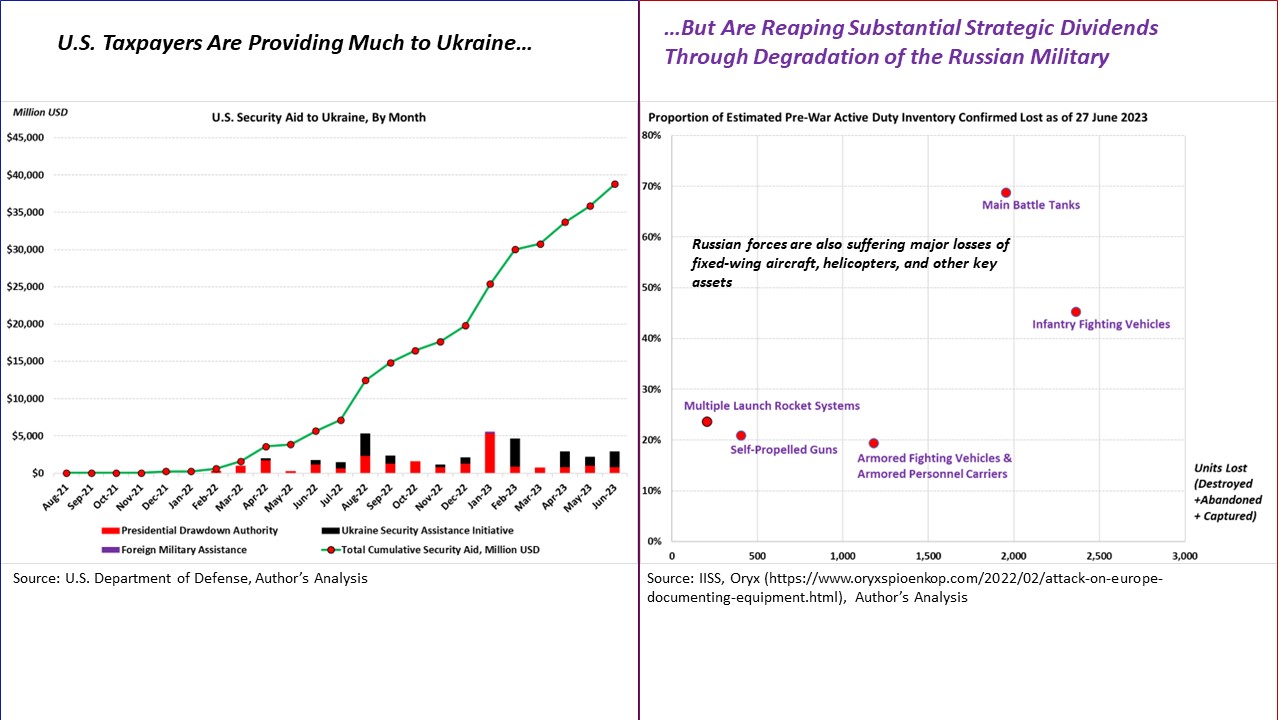
- US military aid to Ukraine, about $40 billion thus far, has substantially degraded the second-largest land army in Eurasia after China’s, supporting core US security interests.
- Oryx and IISS data suggest Russian forces have lost nearly 70% of their pre-war active-duty main battle tanks and about 45% of their infantry fighting vehicles.
- US aid to Ukraine equals about 0.4% of GDP, within the post-Vietnam peak-year range of 0.3% (Gulf War I) to 1.0% (Iraq 2002-2010).
- World War II Lend-Lease would equal about $700 billion today, and the 1991 liberation of Kuwait cost nearly $140 billion, roughly double Ukraine aid so far.
- Direct great power wars cost far more than aiding Ukraine, with Korea at 4.2% of US GDP, World War I at 13.6%, and World War II nearly 36% in peak years.
The initial $48 billion US military aid package for Ukraine that Congress approved in December 2022 is, accounting adjustments notwithstanding, approaching its end. As debate commences in earnest over the level of future support, contemporary and historical data points can help anchor the conversation.
First, consider the positive impacts for American security from a war effort that in financial and equipment terms, has been supported by the US more than any other country (or group of countries, for that matter).
Comparing data from Oryx, a respected external observer of equipment losses in the ongoing war, to 2021 military balance data from the International Institute of Strategic Studies suggests that Russian forces have lost nearly 70% of the active-duty main battle tanks they had prior to the war, about 45% of their infantry fighting vehicles, roughly a quarter of their multiple launch rocket systems, and about 20% of their armored personnel carriers and self-propelled guns.
In other words, a military supply effort led by U.S. taxpayers to the tune of about $40 billion thus far and bolstered by generous contributions of billions more from NATO allies and partners has substantially degraded the second-largest land army in Eurasia after China’s. As such, ensuring a continued flow of equipment and ammunition to Ukraine as it fights for survival is not only the right thing to do, but also substantially supports core US security interests across NATO and the strategic Eurasian landmass. Reducing Russia’s ability to coerce neighboring states and carve off their territory is an abiding US national interest.

Second, what we are spending thus far is well within the bounds of what US policymakers and the voters they answer to have been willing to support in the past when doing what’s right aligns with American strategic interests. During World War II, the US provided Lend-Lease support to allies that in today’s terms would amount to about $700 billion. Between 1946 and Fiscal 2023, the United States has supported Israel to the cumulative tune of an estimated $260 billion (inflation-adjusted). To liberate Kuwait from Saddam Hussein’s tyranny in 1991, the U.S. spent nearly $140 billion (inflation-adjusted). We’ve only spent about half that much so far in Ukraine, a much higher-intensity conflict.
For our wars and security actions since Vietnam, the data show expenditures during the war’s peak year that ranged from 0.3% of GDP (Gulf War I) to 1.0% of GDP (Iraq 2002-2010). U.S. aid to Ukraine thus far during this conflict has been equal to about 0.4% of GDP.
It’s a substantial amount to be sure, but one our dynamic economy can sustain. It’s also much cheaper than the alternative of direct great power conflicts that are far more expensive in blood and treasure (Korea cost 4.2% of U.S. GDP in its peak year, World War I cost 13.6%, and World War II cost nearly 36% of GDP in its most intense year).
Finally, funding Ukraine’s war effort long-term and more intensively communicates to Moscow that it cannot wait out the West and that the costs of trying to retain conquered Ukrainian territory will become unbearable. It also lets China know that attempts at territorial conquest will invite a crushing response. American voters recognize this and Congress should feel empowered to proceed boldly with the next round of Ukraine support appropriations.
Frequently asked questions
How much military aid has the US given Ukraine?
As of June 2023, US taxpayers had funded about $40 billion in military supply to Ukraine, supplemented by billions more from NATO allies and partners. The initial $48 billion US military aid package that Congress approved in December 2022 was, accounting adjustments notwithstanding, approaching its end, prompting debate over the level of future support.
How does US aid to Ukraine compare to past wars as a share of GDP?
US aid to Ukraine has equaled about 0.4% of GDP, which falls within the range of recent US security efforts. Since Vietnam, peak-year war spending ranged from 0.3% of GDP for Gulf War I to 1.0% for Iraq 2002-2010. Korea reached 4.2%, World War I 13.6%, and World War II nearly 36%.
How much of its military equipment has Russia lost in Ukraine?
Russia has lost nearly 70% of the active-duty main battle tanks it had before the war, according to a comparison of Oryx loss data with 2021 IISS military balance figures. The same analysis shows about 45% of infantry fighting vehicles, roughly a quarter of multiple launch rocket systems, and about 20% of armored personnel carriers and self-propelled guns lost.
What would World War II Lend-Lease cost in today’s dollars?
World War II Lend-Lease support to US allies would amount to about $700 billion in today’s terms. Other historical benchmarks include an estimated $260 billion in inflation-adjusted US support to Israel between 1946 and Fiscal 2023, and nearly $140 billion spent to liberate Kuwait in 1991, about twice what Ukraine has received.
Why does Gabriel Collins argue that continued Ukraine aid serves US interests?
Collins argues that sustained aid weakens Russia’s ability to coerce neighbors and seize territory, an abiding US national interest. Funding Ukraine long-term and more intensively signals to Moscow that it cannot wait out the West, and tells China that territorial conquest will invite a crushing response, at far lower cost than direct great power war.




Leave a Reply