Gabriel Collins, J.D., 15 October 2026
Baker Botts Fellow in Energy and Environmental Regulatory Affairs | CES Lead, Energy and Geopolitics in Eurasia
Full Original PDF Available Here: Energy Insights 2026
Key Takeaways: China learned to pursue insulation through self-reliance and electrification; India learned that energy shocks become food and household welfare shocks. China is likely to double down on Electrostate efforts. Their different responses still shape energy policy today.
Introduction: Why the Last Global Energy Crisis Still Matters
The 1973 Oil Shock and Its Strategic Consequences
The last time the world suffered an oil and energy shock as big as what the Iran War and Strait of Hormuz closure have triggered, it was 1973.
China’s General Secretary Xi Jinping was a 20-year-old working in rural Shaanxi Province, where he had been sent down to the countryside during the Cultural Revolution. The Cultural Revolution would not end for three more years. Indira Gandhi was the Prime Minister of India, which was experiencing a massive uptick in human wellbeing due to the Green Revolution entering full swing and ending the famines that had repeatedly stalked the country in earlier years.
Why China and India Remain Relevant Case Studies
Oil was just starting to meaningfully feed each country’s energy metabolism, with India and China obtaining about 10% of their primary energy from oil in 1973, less than half the share oil occupies today. Most of their primary energy came from biomass and coal. As such, they were very differently situated than Japan, which in 1973 obtained approximately 80% of its total primary energy from oil and gas, virtually all of which was imported.
The Central Argument: Energy Shocks Become Security and Welfare Shocks
Today, both China and India each derive approximately 30% of their primary energy supply from oil and gas, with each commodity exposed to the price impacts of a major global disruption like the one now occurring. India is especially exposed, given that it lacks China’s significant domestic oil and gas production.
Both countries are now central cogs in the global energy machine and as such, the essay briefly examines each of their responses to the 1973 Oil Embargo and how steps taken then do (or do not) foreshadow measures they are likely to take in coming years following the Iran War Oil Crisis.
Domestic Oil Production and Strategic Insulation
China’s Response to the 1973 Oil Shock: Self-Reliance and Electrification
China brought the massive Daqing Oilfield into production in 1960, followed by the slightly smaller but still enormous Shengli Oilfield in 1964. Oil production defied the chaos of the Cultural Revolution and grew significantly between 1960 and 1973. China became a net exporter of oil by 1965, primarily to Japan, which had heavily funded the development of the Chinese oil industry through oil-backed loans.
Energy Security as a National Security Priority
China’s positive oil balance meant that—unlike European countries, Japan, and the US—for whom the crisis verged on existential in physical and psychological terms, it was positioned to benefit. As an exporter, China reaped a major windfall from the Arab Oil Embargo. As a declassified CIA report from 1975 put it: “The world oil crisis in the fall of 1973 was a turning point for China’s petroleum industry. A threefold increase in the world price of oil provided the incentive to market crude on a large scale.”1 Oil production chased prices, increasing by nearly 30% between 1973 and 1974.
The area of highest potential risk exposure for China came on the food supply front, where nitrogen fertilizers played a growing role in ensuring the world’s largest population had enough rice and wheat. Here, domestic urea producers using natural gas in Sichuan and coal elsewhere were able to provide nearly ¾ of China’s nitrogen fertilizer needs by the time OPEC launched the 1973 Embargo.2
The Role of Electrification in Reducing Vulnerability
Given China’s heavy emphasis on domestic coal, its oil self-sufficiency, and its high degree of fertilizer production coverage, the 1973 Embargo and the 1979 Iranian Revolution each provided more upside opportunities than they did downside risks. The relative insulation gave the Party space for information warfare.
How China’s Self-Reliance Strategy Still Shapes Policy
The CCP’s line was perhaps best summed up in the 15 March 1974 issue of Peking Review, which framed the oil crisis as a struggle “against imperialism and hegemonism” by the United States and Soviet Union.3 Party propaganda also extolled the virtues of energy self-reliance, saying that “Guided by Chairman Mao’s revolutionary line, the Chinese people have carried out the principle of maintaining independence and keeping the initiative in their own hands and relying on their own efforts.”4
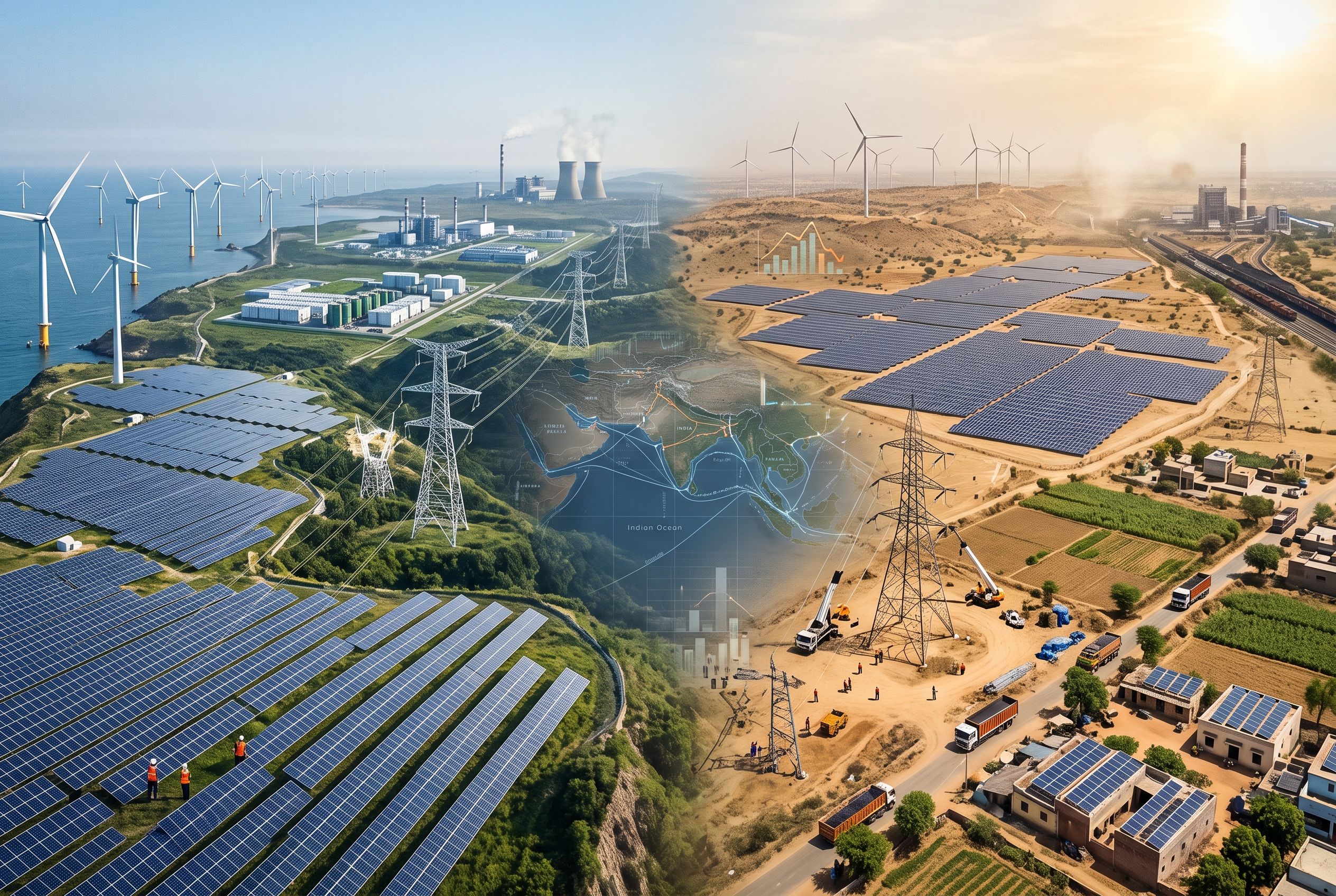
The emphasis on self-reliance still guides PRC energy security thinking today, more than 50 years later.5 As we contemplate China’s trajectory from this point forth, the Iran War energy and commodity shock is likely to drive three core outcomes: (1) Beijing will continue apace in its attempts to continue expanding its Electrostate and the relative insulation that confers from global oil and gas price volatility, (2) China will also continue building out oil storage capacity because despite electrification, about 20% of the country’s total primary energy use and a much larger portion of transportation energy demand is served by oil, and (3) China-linked entities are likely to play significant roles in helping finance alternative infrastructure aimed at diminishing the strategic risks posed by key chokepoints such as the Strait of Hormuz.6
India’s Response: Food Security, Fertilizer, and Household Welfare
Why India Experienced the Crisis Differently
“Ensuring energy security for future generations is one of our biggest challenges. We consider it not only a priority but also as a responsibility towards our citizens.”
— Prime Minister Narendra Modi, 18 June 20257
China has gotten a lot of the attention in the past 25 years, but India’s energy demand growth has been equally remarkable. A country that used less energy than Germany in 2000 now uses as much as Germany, Belgium, France, Italy, Spain, and the UK combined.8 Compared to others in its region, India uses basically as much energy as all of its South and Southeast Asian neighbors combined.9 Despite this expansion, it is still growing, with a per capital primary energy usage a bit less than ¼ that of China.
The Link Between Energy, Fertilizer, and Food Security
For this emerging energy titan, fossil fuels remain foundational, led by coal at about 52% of primary energy in 2025 and oil at 24%. Biomass checks in at about 11% and other sources trail thereafter. Indeed, one of India’s most underappreciated energy stories has been the shift in fuel mix over the past 125 years from a system dominated by biomass to one dominated by modern energy sources.
Figure 1 — India Total Primary Energy Use by Source, 1900-2025 (Exajoules)

Urea Subsidies and the Expansion of State Support
Sources: India 1900–1947: Great Britain, India Office, Statistical Abstract Relating to British India, 1st–55th numbers (London: HMSO, 1867–1921), continued as India, Department of Commercial Intelligence and Statistics, Statistical Abstract for British India, with Statistics, Where Available, Relating to Certain Indian States (Calcutta and Delhi, 1922–1943); volumes digitised by the Digital South Asia Library, University of Chicago. India 1947–1964: India, Central Statistical Organisation, Statistical Abstract of the Indian Union (New Delhi, 1949– ), with electricity backfilled from Central Electricity Authority, Growth of Electricity Sector in India from 1947 Onwards(New Delhi, annual). India 1965–2024: Central Electricity Authority, All India Electricity Statistics: General Review 2025 (New Delhi: Ministry of Power, 2025), data year 2023–24; India, National Statistics Office, Energy Statistics India 2026, 33rd ed. (New Delhi: Ministry of Statistics and Programme Implementation, 2026); India, Ministry of Coal, “Ministry of Coal’s Year End Review–2025,” Press Information Bureau release PRID 2213723, 12 January 2026; U.S. Energy Information Administration, Country Analysis Brief: India (Washington, DC: U.S. Department of Energy, 6 February 2025); and Ember, India Electricity Data Explorer and India Electricity Data (State-Level) (Ember Energy Research CIC), used under CC-BY-4.0. Sectoral and institutional framing follows B. R. Tomlinson, The Economy of Modern India: From 1860 to the Twenty-First Century, 2nd ed., New Cambridge History of India III.3 (Cambridge: Cambridge University Press, 2013), and Amiya Kumar Bagchi, Private Investment in India, 1900–1939, Cambridge South Asian Studies 10 (Cambridge: Cambridge University Press, 1972). Note: Indian figures are reported on an April–March fiscal year and are not calendarised. Coal production for FY 2024-25 is 1,047.52 Mt, up 4.98% on 997.83 Mt in FY 2023-24. The CEA General Review publishes one year in arrears. Ember’s state-level series begins in 2019 and is not used for earlier years.
The shift matters greatly for human betterment. It matters for pollution given coal’s present centrality. And it matters for Indian energy security. Energy shocks of the 1970s that seared consumers and policymakers across the OECD world registered differently within India. At that point in time, it was much less about cars and much more about food. Many Indian homes still cooked and heated with biomass, but the agricultural sector was the first to become coupled to global oil and gas geopolitics and the price volatility that followed closely behind.
How Energy Disruptions Affect Indian Households
In the 1960s, India was viewed as being on an unchangeable road toward famine.10 Yet by the early 1970s, the Green Revolution was transforming the country’s staple grain production and prospects for feeding its burgeoning population. Fertilizer was one of the most important growth-driving inputs, especially for wheat and rice, with fertilizer use rising from 100,000 tonnes in the 1950-51 crop year to 3.2 million tonnes in the 1973-1974 crop year.11
India’s Continuing Dependence on External Energy Supplies
Figure 2 — Urea Subsidy Share of India Federal Budget vs. Oil Price, 1960-2025

What China and India Learned From the Energy Crisis
China’s Lesson: Reduce Exposure Through Domestic Capacity
Source: PIB/Department of Fertilizers press releases and annual reports; IEEFA, LNG in Indian Fertiliser Sector; ICAR-IARI Policy Brief 2025; Ansari & Sheereen, Saudi Journal of Economics and Finance; CDS Trivandrum Working Paper 506-AJIL; CAG audit reports on fertilizer subsidy; IIM-A Sharma 2009; Fertiliser Association of India annual reviews; and Energy Institute, Statistical Review of World Energy. Data compiled with assistance of Anthropic’s Claude Opus 4.8 and Fable 5 models.
India’s Lesson: Protect Food and Household Welfare
During that time, problems within India’s domestic fertilizer sector led to increasing reliance on imports. Between growth in nitrogen fertilizer inputs and the explosive spike in crude oil prices during the 1973 Arab Oil Embargo (which increased the cost of naphtha feedstock used by fertilizer plants), the stage was set for a fertilizer crisis. Farmers applied less fertilizer in 1974, grain output suffered, and hunger gripped India.12
The Shared Lesson: Energy Security Requires Resilience
In response, the Indian government began subsidizing urea fertilizer prices in 1977. Since that time, major global oil price spikes—which tend to drag the entire commodity complex up with them—have driven major increases in the Indian government’s urea fertilizer subsidy burden. For instance, the 2008 oil price spike caused urea subsidy outlays to more than 8% of the entire Indian federal budget that year and nearly 4% in 2022 when the Russian full-scale invasion of Ukraine drove oil prices up.
Where China and India’s Strategies Diverge
Fast forward to 2026, and urea scarcity and price spikes—this time driven by the Strait of Hormuz closure—are once again a serious problem for India’s farmers. Energy security and food security are once again closely intertwined.13 For perspective, if India spent 6% of its budget on urea subsidies, this would be approximately equivalent to roughly twice the U.S. Department of Energy’s enacted budget in Fiscal Year 2025—in short, a substantial amount of money.14
The ongoing energy shock also found a second pathway into Indian kitchens: liquefied petroleum gas. As shipments of LPG through the Strait of Hormuz dwindled in early March 2026, Indian consumers were one of the first groups impacted. LPG is important as an industrial fuel, but of particular political salience, is a vital cooking fuel, as it displaces smoky biomass that was a major driver of respiratory disease. Attention to the LPG issue rose to the highest levels very rapidly.15
China’s Drive Toward Greater Energy Insulation
The disruptions from today’s crisis creates four areas worth watching in India’s energy decision-making in the coming year: (1) the country is likely to deepen its use of coal as a secure source of electricity, (2) it will likely accelerate the expansion of crude oil and products storage, (3) it will likely encourage greater electrification in areas such as cooking so as to displace imported LNG with more secure domestic coal and renewables, and (4) it will likely consider new investments in domestic, coal-based nitrogen fertilizer production16 This will have meaningful electricity demand impacts because depending on usage patterns, every million homes that adopt induction cooking in the place of LPG could potentially add 2 gigawatts of load, with breakfast and dinner coinciding with lower solar power output.17
Conclusion: Energy Security Lessons for the Future
China learned that energy self-reliance is the most durable form of insulation from global price volatility. In 1973, China was already a net oil exporter — primarily to Japan — and its heavy reliance on domestic coal and its own oil and gas production meant that the Arab Oil Embargo posed more upside opportunity than downside risk. The CCP codified this experience into a doctrine of independence and self-sufficiency, summarised in the 1974 Peking Review as relying on China’s own efforts. That principle still guides Chinese energy security policy more than 50 years later, expressed today through the expansion of the Electrostate — an economy increasingly insulated from global fossil-fuel price swings through domestic electrification — alongside growing oil storage capacity and efforts to finance alternative infrastructure that reduces dependence on chokepoints such as the Strait of Hormuz.
What did India learn from the 1973 oil shock?
India learned that an energy shock rapidly becomes a food and household-welfare shock. In 1973, India’s agricultural sector was tightly coupled to global oil and gas prices through its dependence on nitrogen fertilizer, primarily urea, whose production relied on oil-derived naphtha feedstock. The spike in crude prices during the Arab Oil Embargo raised fertilizer costs, caused farmers to apply less urea in 1974, reduced grain output, and contributed to hunger. India’s response — beginning urea price subsidies in 1977 — reflects the lesson that protecting food security requires buffering households from the full impact of global energy price volatility. That lesson still shapes Indian policy: major oil price spikes in 2008 and 2022 each drove large increases in the government’s urea subsidy burden, and the 2026 Strait of Hormuz closure has again made urea scarcity and LPG shortages central policy concerns.
Why do energy shocks become food and household-welfare shocks?
Energy shocks transmit into food and household welfare through two main channels. First, nitrogen fertilizers such as urea are manufactured from fossil-fuel feedstocks — naphtha or natural gas — so a spike in oil or gas prices directly raises fertilizer production costs. When farmers respond by applying less fertilizer, crop yields fall and food prices rise, a sequence that unfolded in India in 1974 and is repeating in 2026. Second, imported fuels used directly in households — such as LPG for cooking — become scarce or unaffordable when supply chains are disrupted, as occurred in India in early 2026 when Strait of Hormuz shipments dwindled. Because LPG displaces smoky biomass that drives respiratory disease, its loss carries both an economic and a public-health cost. The two channels together mean that a country heavily reliant on imported oil and gas faces welfare consequences that extend well beyond the fuel pump.
Will India follow China toward an Electrostate model?
India is moving toward greater electrification, but its path differs from China’s in important ways. The 2026 energy shock is expected to accelerate four Indian policy responses: deepening coal use for electricity generation, expanding crude oil and products storage, encouraging electrification of cooking to displace imported LPG with domestic coal and renewables, and investing in domestic coal-based nitrogen fertilizer production. Each of these is consistent with the logic of an Electrostate — reducing exposure to imported fossil-fuel price volatility.
However, India’s primary energy system remains dominated by coal at roughly 52% and oil at 24%, with biomass still playing a significant role. India also lacks China’s significant domestic oil and gas production and its fiscal and technological firepower. India will therefore emphasize food security and household wellbeing alongside electrification, rather than pursuing the same concentrated industrial strategy China has deployed. Both countries will lean on coal to accomplish their objectives, and their choices will shape global energy markets far beyond Asia.
The Risk of Energy Shocks Becoming Food and Economic Shocks
Even before the Iran War, 2026 was poised to test the resilience of global energy systems. The conflict has now pulled the system tight and is accelerating energy securitization efforts, particularly in the large consumer countries that have the resource bases, incentives, and fiscal plus technological firepower to try and reshape the system to their relative benefit.
Will India Follow China Toward an “Electrostate” Model?
China will work to deepen its insulation from global events while maximizing the outside world’s relative dependence on Chinese manufactured goods, including non-fossil energy equipment. India will emphasize food security, household wellbeing, and insulation through electrification. Both countries will lean on coal to accomplish these objectives, and their actions will shape global energy markets far beyond Asia.
Related Research
• Energy Disruption Dashboard
• Datacenter Disruption Dashboard
• Eurasia Energy, Food, Water, and Security Quarterly
• Energy and Water Research, With Special Focus On Eurasia
• Research Products
Notes
1. Central Intelligence Agency, China Builds Pipelines to Boost Petroleum Exports, Intelligence Report ER IR 75-18, June 1975, CIA Freedom of Information Act Electronic Reading Room, https://www.cia.gov/readingroom/docs/CIA-RDP86T00608R000500200019-6.pdf.
2. Food and Agriculture Organization of the United Nations. FAOSTAT: Fertilizers by Nutrient. Rome: FAO, 2026. Accessed June 2, 2026. https://www.fao.org/faostat/en/#data/RFN, Ma, Xinhua. (2017). Natural gas and energy revolution: A case study of Sichuan–Chongqing gas province. Natural Gas Industry B. 4. 10.1016/j.ngib.2017.07.014
3. Chang, Chien. 1974. “Behind the So-Called ‘Energy Crisis’.” Peking Review 17, no. 11 (March 15, 1974): 5-7. https://massline.org/PekingReview/PR1974/PR1974-11.pdf.
4. Ibid
5. Gabriel Collins, “Energy as a Strategic Space for China: Words and Actions Point to a Competitive Future,” Mapping China’s Strategic Space, National Bureau of Asian Research (NBR), February 28, 2024, https://strategicspace.nbr.org/energy-as-a-strategic-space-for-china-words-and-actions-point-to-a-competitive-future/.
6. Gabriel Collins, “Wars and Pipelines: How Armed Conflict Has Driven Oil Logistics Diversification,” Rice University’s Baker Institute for Public Policy, April 9, 2026, https://doi.org/10.25613/VSN3-ZT23.
7. Narendra Modi, “Ensuring Energy Security for Our Citizens Is Not Just a Priority, but Also a Responsibility: PM Modi at G7 Summit Session” (speech, G7 Summit Outreach Session, Kananaskis, Canada, June 17, 2025), narendramodi.in, June 18, 2025, https://www.narendramodi.in/ensuring-energy-security-for-our-citizens-is-not-just-a-priority-but-also-a-responsibility-prime-minister-narendra-modi-at-g7-summit-session-594543
8. Energy Institute, Statistical Review of World Energy 2025, 74th ed. (London: Energy Institute, in collaboration with Kearney and KPMG, 2025), https://www.energyinst.org/statistical-review
9. Ibid.
10. Sid Ravinutala, “Redesigning India’s Urea Policy” (Master’s thesis, Harvard University, 2016), Page 5, https://www.hks.harvard.edu/sites/default/files/degree%20programs/MPAID/files/Redesigning%20India’s%20Urea%20Policy_SYPA_Sid%20Ravinutala_2016.pdf.
11. Power, Paul F. “The Energy Crisis and Indian Development.” Asian Survey 15, no. 4 (1975): 328–45. https://doi-org.ezproxy.rice.edu/10.2307/2643237.
12. Bernard Weinraub, “India Requesting Food Aid from U.S.,” New York Times, September 3, 1974, https://www.nytimes.com/1974/09/03/archives/india-requesting-food-aid-from-us-seeks-emergency-help-but-shuns-a.html.
13. Morgan D. Bazilian, Gabriel Collins, and Jahara Matisek, “A Closed Strait of Hormuz Risks a Global Food Security Crisis,” War on the Rocks, April 13, 2026, https://warontherocks.com/a-closed-strait-of-hormuz-risks-a-global-food-security-crisis/
14. Office of Management and Budget, Technical Supplement to the 2026 Budget: Appendix, Budget of the United States Government, Fiscal Year 2026 (Washington, DC: U.S. Government Publishing Office, 2025), https://www.govinfo.gov/content/pkg/BUDGET-2026-APP/pdf/BUDGET-2026-APP-2.pdf
15. Swapnil Joglekar, Utsav Basu, and Deeptiman Tiwary, “India LPG Gas Shortage News Live Updates: ‘Conflict Has Affected Stainless Steel Manufacturing,’ Abhyuday Jindal Says,” Indian Express, updated March 13, 2026, https://indianexpress.com/article/india/india-lpg-gas-shortage-live-updates-iran-israel-restaurants-petrol-pumps-10576531/
16. Gabriel Collins, “Electricity Is the Ultimate Climate Adaptation Commodity,” The Sinews of Civilization, Substack, 1 June 2026. https://gabrielcollins.substack.com/p/electricity-is-the-ultimate-climate
17. Flipkart. “Buy Induction Stoves & Cooktops Online.” Accessed June 10, 2026. https://www.flipkart.com/induction-cooktops/pr?sid=j9e%2Cm38%2C575

Leave a Reply