Where does geopolitical rivalry enter a company’s operations?
In this 27 November 2023 ideas deck, Gabriel Collins examines how strategic competition changes the environment in which multinational companies operate. The presentation connects state power to commercial decisions, then separates broad geopolitical exposure from risks to individual firms. Its examples and forward-looking judgments are those of the 2023 presentation.
How can political conflict change a commercial relationship?
The opening framework follows a feedback loop among political power, market actions and reactions. It then maps instruments that range from trade and financial measures to infrastructure disruption. Read these as channels through which a business relationship can acquire strategic significance, rather than assuming that economic interdependence removes conflict. Political and market feedback, slide 3; channels of competition, slide 6.
Which exposures belong on a company’s own map?
The risk taxonomy distinguishes sector-wide shocks from firm-specific pressures. It is useful for organizing questions about market access, personnel, intellectual property, transactions and physical assets. A company may be exposed through suppliers and customers as well as through its own direct presence. Sector and firm risks, slide 16.
Why does the warning horizon matter?
The deck compares several crisis scenarios with different possible warning periods. The analytical lesson is to distinguish actions that require advance preparation from choices that remain available during a crisis. These illustrative timelines should retain their original date and scenario assumptions. Warning horizons, slide 11.
When do private assets become national capabilities?
The corporate examples connect technology, industrial capacity and privately held materials to national security. They help explain why a firm’s strategic importance can affect its freedom of action even when management would prefer a purely commercial relationship. Corporate capabilities, slides 13–15.
Continue with U.S. corporations and China–Taiwan war risk and the research on competition with China through 2035.
Suggested Citation: Gabriel Collins, “Great Power Rivalry & Evolving
Risks For Multinational Corporations,” Ideas Deck, 27 November 2023, https://collinsresearchportal.com/wp-content/uploads/2023/11/collins_great-power-competition-and-evolving-risks-for-multinational-corporates_27-november-2023.pdf
The golden age of globalization that existed between 1991 and the mid-2010s has now decisively closed. Global trade is still vital and pockets of opportunities abound, but the geopolitical load that trade & transactions occur under is now far heavier than at any point since the Cold War era. Most of today’s business leadership class was formatively shaped by a world of relatively unfettered access to opportunity, one where political and geostrategic concerns took a back seat compared to production and transport economics. That world is now firmly in the rearview.

Geopolitical competition is now reasserting itself in a big way. Furthermore, the landscape is far more complex than it was during the Cold War, when the world was cleft into two large, relatively neatly defined blocs (three if you count the Non-Aligned Movement). Now, no matter where you are located or what you produce and trade, it’s almost impossible to avoid contact with the rival and intertwined Chinese and American commercial ecosystems and barring a massive war, this state of affairs looks likely to endure for decades to come. Welcome to “Great Power Rivalry & Evolving Risks for Multinational Corporations!” The full presentation can be downloaded here.
Original slides and transcript
Full text of the slides (from the PDF)
Slide 1. Great Power Rivalry & Evolving
Risks For Multinational Corporations
Gabriel Collins, J.D., Rice University’s Baker Institute for Public Policy, Center for Energy Studies; Co-Head, Program on Energy & Geopolitics in Eurasia gabe.collins@rice.edu https://www.bakerinstitute.org/expert/gabriel-collins https://www.linkedin.com/in/gabecollins https://collinsresearchportal.com/ 27 November 2023
Slide 2. Disclaimer & Disclosure
This analysis reflects personal opinions and assessments only. It is designed solely to be illustrative and stimulate broader thought, with the objective of providing insight and elevating the conversation in the energy, policy, and water spaces. It IS NOT an investment analysis or investment advice. It is also NOT offering any legal opinions or advice and does not create an attorney-client relationship with any reader or consumer of the information presented herein. Readers rely on the information in this analysis at their own risk. Neither the author nor Caracal Commodities, LLC nor the Baker Institute for Public
Policy are liable for any loss or damage caused by a reader’s reliance on information contained in any of the charts, data series, opinions, or other information presented herein. The information and opinions contained in, and expressed by this analysis, are based on sources deemed reliable. However, there is no warranty, assurance, or guarantee, express or implied, about the completeness, reliability, or accuracy of this content. The views expressed herein are my interpretations as of the date the report is published and are subject to change without notice.
DISCLAIMER: The opinions expressed in this briefing are those of the author’s alone and do not represent those of any other organizations with which he has been, or is currently, affiliated.
Slide 3. The Domestic & International Political/Economic
Feedback Loop
Market
Actions
Political
Reactions
Market
Reactions
Political
Power
• Those who control political power and how they use it profoundly shape economic relationships.
• Political power’s importance over economic structures is dramatically magnified in the international arena, where there is no sovereign authority to manage or adjudicate disputes.
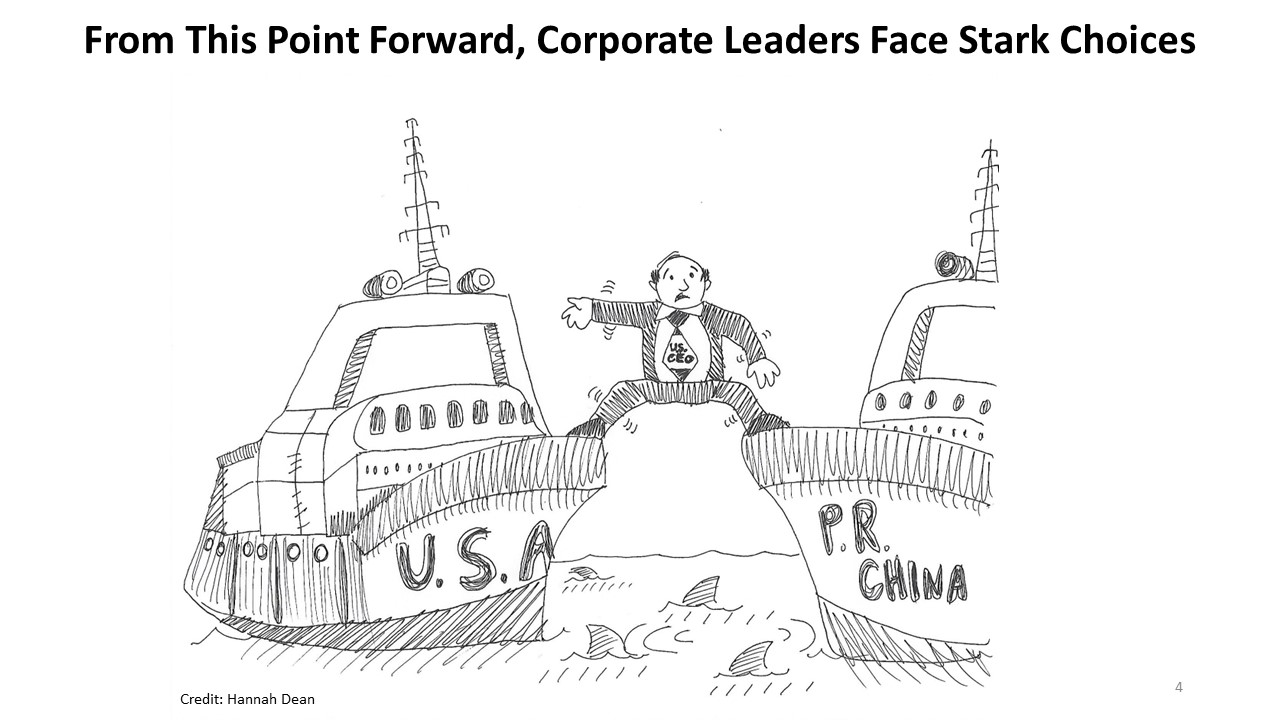
Slide 4. From This Point Forward, Corporate Leaders Face Stark Choices
Credit: Hannah Dean 4
Slide 5. US-China Relationship Is Now a Rivalry and Frames Interactions With Entire “Axis of Autocracy”
“Rivalry” between nation-states means a combination of: “relationship characterized by extreme competition, and usually psychological hostility, in which the issue positions of contenders are governed primarily by their attitude toward each other rather than by the stakes at hand.,” “militarized interstate competition in which some cases are more enduring than others,” and “a competitive relationship between independent states where both states identify the other as an enemy and an explicit threat.”* Rivalries are pervaded by a zero-sum mindset.
*John A. Vasquez, “Distinguishing Rivals That Go to War from Those That Do Not: A Quantitative Comparative Case Study of the Two Paths to War,” International Studies Quarterly, Vol. 40, No. 4, December 1996.; Gary Goertz and Paul F. Diehl, “War and Peace in International Rivalry,” Ann Arbor: University of Michigan Press (2000); William R. Thompson, “Identifying Rivals and Rivalries in World Politics,” International Studies Quarterly 45 (4): 557-587 (2001)
Characteristics of Rivalry With Elevated War Risk Present in US-China Rivalry Today?
High level of resource mobilization against rival Yes
Government identifies rival as top threat Yes
Acrimonious array of intractable positional & territorial disputes Yes
Two or more militarized crises/volatility points Yes, incl. via alliance commitments
Elevated levels of defense spending, capabilities clearly target rival’s military Yes
Intense effort to build coalition targeting rival Yes
Multiple parallel & overlapping rivalries Yes
Source: Author’s Analysis based on metrics from Heath, Timothy R., Kristen Gunness, and Tristan Finazzo, The Return of Great Power War: Scenarios of Systemic Conflict Between the United States and China. Santa Monica, CA: RAND Corporation, 2022. https://www.rand.org/pubs/research_reports/RRA830-1.html.
Commercial Actors Must Navigate an Emerging World of Nation-State Rivalries
Slide 6. Non-Military Trans-Military Military
• Financial warfare
• Trade manipulation
• Economic aid
• Sanctions
• Regulatory actions
• Standards warfare
• Legal warfare
• Smuggling
• Illicit substances
• Information/influence operations
• Resource competition
• Ecological/climate warfare
• Energy supply manipulation
• Sponsorship of non-state proxies
• Terrorism
• Infrastructure warfare
• Destructive (Nord Stream)
• Shaping (dual-use ports)
• Covert operations
• Supply chain tampering
• Platform warfare
• Intermittent blockades
• Conventional warfare
• Low intensity
• High intensity
• Space warfare
• Electronic warfare
• Biological/chemical warfare
• Nuclear warfare
Cyber operations
In a Rival, But Globalized, World Everything Can be a Weapon
Slide 7. …And Countries May Knife Fight While Economically Tied Together
COMECON
Modern PRC Investment Footprint https://en.wikipedia.org/wiki/Comecon#/media/File:Comecon.svg
Economic Blocs Are Much More Complex and Dynamic Than in Cold War…Source: AEI China Global Investment Tracker, Author’s Analysis
Slide 8. Blurred Lines: Commerce, Warfare, a Bit of Both?
Russian/FSU Pipeline Gas Supplies Into Europe
Source: ENTSOG, Gasunie (conversion data), Author’s Analysis
European gas demand recovered substantially after
COVID shutdowns eased in early 2021…but Gazprom chose to sharply reduce supplies
Governmental Jockeying For Strategic Metals
Slide 9. Future Wars Could Be More Violent Than Ukraine
More Than 7,800 Cumulative Strike Munitions* Used Thus Far
Source: Defense Express, US Defense Department, Pravda UA, Suspilne, Ukrinform, Ukrainian Air Force
Note: This is likely an undercount, as it relies substantially on intercept data that do not always show how many munitions Russian forces launched
• In a US-China fight, mass, precision, and truly global strike capabilities will on be on the table.
• Consider the uplift in sheer kinetic violence relative to the last Pacific war:
• Modern super/hypersonic anti-ship missiles pack a kinetic + warhead punch that can be 10X what a kamikaze aircraft or 18-inch battleship shell would have unleashed
Slide 10. Reported PRC Aircraft Entries Into Taiwan Air Defense
Identification Zone and/or Crossing Taiwan Strait Median
Line, Daily
Reported PRC Air Sorties Into ADIZ/Across Median Line, Monthly
Source: Taiwan MoD, https://docs.google.com/spreadsheets/d/1qbfYF0VgDBJoFZN5elpZwNTiKZ4nvCUcs5a7oYwm52g/edit#gid=653770221, Author’s Analysis
Revisionist Powers Continue Ramping Up Coercive Pressure Against US Partners
Slide 11. We Are Squarely In The Window of Maximum Danger
Action Warning Timetable
Maritime Militia actions against Taiwan’s outlying islands such as Pratas
Days
PLA blockade of Taiwan’s outlying islands Days
Invasion of Kinmen or other outlying Taiwanese islands
Weeks
Customs quarantine possibly escalating to maritime blockade of Taiwan
Days/Weeks
Missile/Air “exercises” to disrupt air and maritime traffic into Taiwan
Hours/Days
Full invasion of Taiwan Weeks/Months
Sources: David Lague and Maryanne Murray, “War Games—T-Day: The Battle for Taiwan,” Reuters, November 5, 2021, https://www.reuters.com/investigates/specialreport/taiwan-china-wargames/; authors’ analysis 11
Slide 12. And Many Decades of Strategic Competition Likely Lie Ahead
• Even if demographic & economic factors short circuit China’s quest for superpowerdom, in most scenarios short of collapse, it will pose a multidecade competitive challenge.
• Russia is a “persistent power” but we don’t really have a contemporary model for what a post-Decade of Danger China might look like.
Prevailing in one strategic contest…
…does not necessarily end the competitive challenge.
Sources: The Guardian, CNN
25 December 1991
15 August 2022
Slide 13. Multinational Corporations Are National Security Assets
WWII Now China’s Parastatals
Willow Run
Richmond Shipyards
Your competitive position may choose a side for you, whether you overtly want that or not
Slide 14. Corporate Importance Exhibit A: NVIDIA
• Classic case of a corporate entity that does not want to choose sides but will likely be forced to as geopolitical dividing lines harden.
• Its commanding position in GPU technology makes it the premier
“picks and shovels” business in today’s unfolding AI gold rush.
• But the company’s exposure to the China market raises pointed questions as to how its chips potentially help power the economy and military of the United States’ Near Peer
Competitor.
• And sales are higher than ever…
• Expect more export control attention from the Commerce
Department in coming months.
NVIDIA Sales to China, Quarterly (Million USD)
Source: Company 10-Q Reports
Slide 15. Private Corporations Own/Operate Critical Assets and Hold Materials Inventories That Government Used To Hold Itself
US 1980 National Defense Stockpile: Desired vs. Actual Inventory
15Source: Stockpile report to the Congress. 980-84/85, USGS, USGS Archive (https://search.library.wisc.edu/digital/AZJDITAWX26DJC9C/full/A42RR6TSPSXA7P8D), Author’s Analysis
Artillery rockets
Amoxicillin
Slide 16. Securitization Amplifies Risks: China Exposure Examples
Sector-Level Risks
• Full Kinetic War (highest impact, lowest probability)
• Blockade/Embargo
• Damaging Cyberattacks
• Export controls/sanctions
Firm-Specific Risks
• Employee detentions
• Raids
• Boycotts
• IP Theft
• Merger/Transaction approval withholdings
• Rejection of cargoes/punishment by demurrage
• Industrial espionage/passing of information to competitors
• Shadow business expropriation through “informal” regulatory action
Slide 17. Thank You!
Check Out My Research: https://www.bakerinstitute.org/expert/gabriel-collins https://www.bakerinstitute.org/program/program-energy-and-geopolitics-eurasia https://www.linkedin.com/in/gabecollins/ https://collinsresearchportal.com/ Stay in Touch:
Gabriel Collins, J.D. gabe.collins@rice.edu
Frequently asked questions
Is the era of globalization over for multinational companies?
According to Gabriel Collins, the golden age of globalization that ran from 1991 to the mid-2010s has decisively closed. Global trade remains vital and opportunities still exist, but trade and transactions now carry a heavier geopolitical load than at any point since the Cold War era, changing how multinational corporations must assess risk.
Why is US-China rivalry a risk for multinational corporations?
US-China rivalry is a risk because companies can hardly avoid contact with the rival and intertwined Chinese and American commercial ecosystems, wherever they operate or whatever they trade. Collins judges that, barring a massive war, this situation looks likely to endure for decades, so political and strategic concerns now weigh alongside production and transport economics.
How is today’s great power competition different from the Cold War?
Today’s great power competition is more complex than the Cold War. During the Cold War, the world was divided into two large, relatively neatly defined blocs, or three counting the Non-Aligned Movement. Now the Chinese and American commercial ecosystems are both rival and intertwined, making it far harder for firms to sort partners and markets cleanly.
Does the US-China relationship meet the definition of a rivalry with war risk?
Collins concludes that it does. Using metrics drawn from a 2022 RAND Corporation study, his analysis finds the US-China relationship shows every listed trait of a rivalry with elevated war risk, including high resource mobilization, territorial disputes, multiple militarized crises and coalition building, and says it frames interactions with an entire axis of autocracy.


Leave a Reply