Gabriel Collins, J.D. and Chris Bronk, Ph.D.*
Full Citation: Gabriel Collins, J.D. and Chris Bronk, Ph.D., “Long-Range Ukrainian Kamikaze Drones Would Raise Costs of Russia’s Infrastructure War,” Collins Research Portal, 14 October 2022, https://collinsresearchportal.com/2022/10/14/long-range-ukrainian-kamikaze-drones-would-raise-costs-of-russias-infrastructure-war/
The gray rhino in Ukraine right now is most likely not a nuclear detonation, but rather, the continued “infrastructure war” by Russia that seeks to comprehensively destroy Ukraine’s industrial and energy systems, terrorize civilians, and freeze them into submission during the coming winter. Russia will not win the war this way, but each round of strikes adds to the cost and time of rebuilding (already likely to cost hundreds of billions of dollars and take years). Defensive steps are now in full swing, for instance accelerated NATO deliveries of NASAMS and IRIS-T SLM air defense systems and the missiles to feed them.
Yet defense alone has limits in a country with critical infrastructure spread across an area nearly the size of Texas. Kyiv needs offensive options too so that it can make clear to Moscow that there will no longer be impunity for the Russian campaign against distinctly non-military targets in Ukraine. Sending ATACMS short-range ballistic missiles would be a superb start but it does not appear that US policymakers are yet willing to accept the incremental risk associated with such an upgrade to Kyiv’s arsenal. There is also another shortcoming: ATACMS rockets “only” have a 300 km range–insufficient to hold key Russian targets at risk. As such, Ukraine needs 1000km-class strike systems and they need to be as “indigenized” as possible to allow volume production and confer operational freedom. “Austere Drone Fab” should enter the Ukrainian and NATO lexicons.
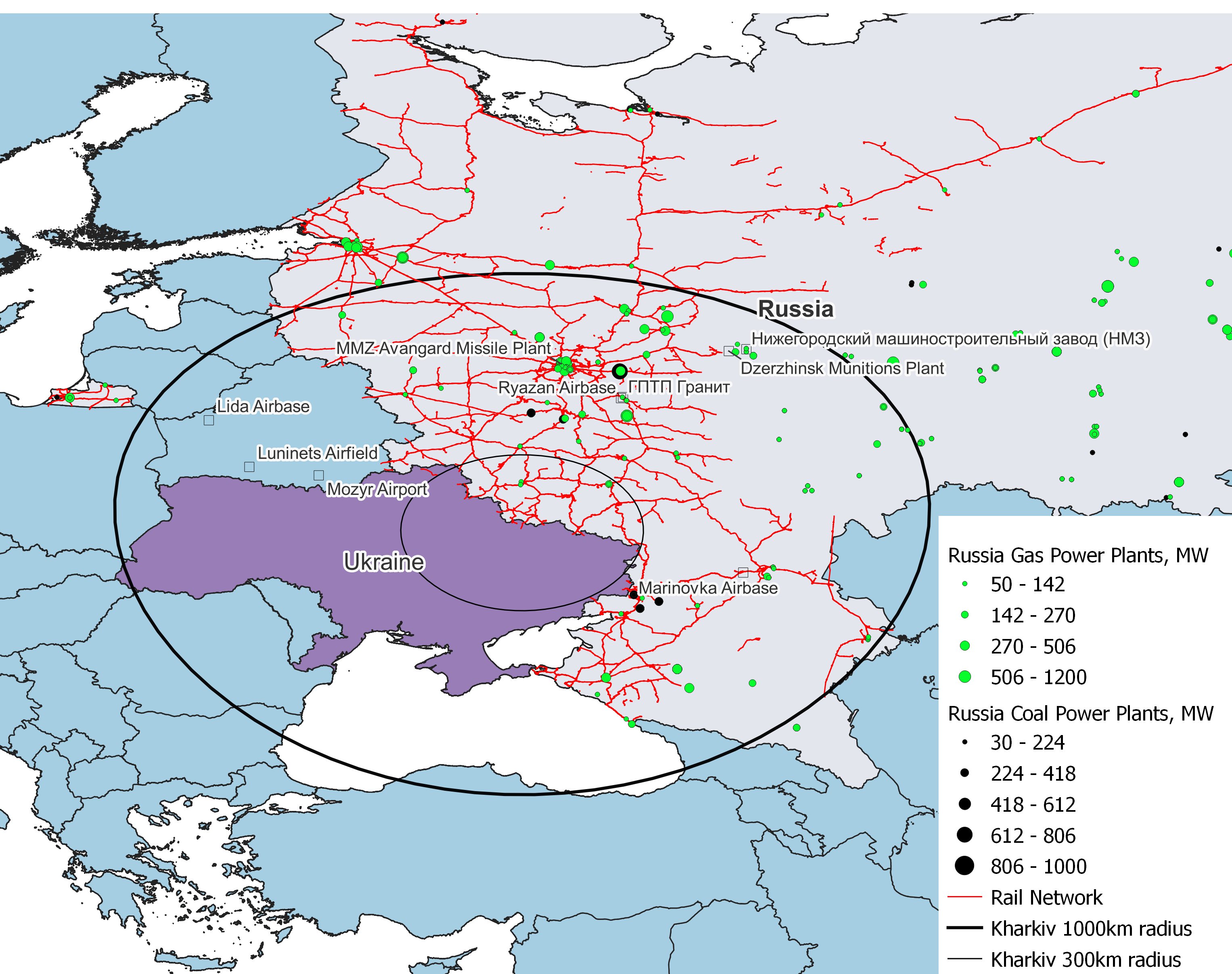
Houthi rebels’ disruptive drone warfare campaign against Saudi Arabia and the UAE offers a template for low-cost, scalable, and impactful kamikaze drone operations. With appropriate sensors, Ukrainian kamikaze UAS could target airfields in Belarus and Russia, power plants, seaports, Russian industrial facilities and munitions plants, staging areas, and railways. And they could do this at a high rate of fire, potentially for years if necessary. Violent reciprocity is a language the Kremlin understands well. Ukraine has pulled off a number of impressive deep strikes on high-value Russian targets like an oil depot near Belgorod, the Novoshakhtinsk oil refinery, and the Saki Airbase in occupied Crimea but needs the ability to scale up for strategic effect. As the simple map below shows, Western Russia and Belarus would offer a target-rich environment for a Ukrainian drone counterwar.
Selected Industrial and Military Assets That Would Be Within Range of Ukrainian Long-Range Drones

If the Houthi operations offer a guide, Ukrainian drone warriors could potentially target Russian assets at ranges verging on 1,000 km. The impacts on Russian military logistics and aircraft basing would be profound. Airbases in Belarus and Western Russia host strike aircraft, helicopters, and even A-50 airborne early warning aircraft— but thus far have operated with relative impunity, save for a few Ukrainian counterstrikes with very short range (70km) Tochka-U ballistic missiles. Long-range precision UAS swarms launched from havens in Western and Central Ukraine could reach virtually all of these facilities. Russian forces would take the threat seriously having suffered casualties and aircraft damage from UAS strikes against the Khmeimim Airbase in January 2018.
As of December 2021, Houthi forces had reportedly fired more than 850 drones against targets in Saudi Arabia during the preceding 7 years. The pace varied, with the Houthis alleging in March 2021 that they unleashed a salvo of 18 armed drones in a single day at various facilities in Saudi Arabia. Ukrainian forces could likely operate at a higher sustained launch tempo with more advanced UAS systems given the country’s indigenous technical expertise and, almost assuredly, significant materiel support from NATO members.
Ukrainian drone fabs would have access to a much wider range of parts than the Houthis and their Iranian sponsors, including world-class guidance systems, multi-effect warheads, and fuzes, since they would not have to contend with export controls. Kamikaze drones producible at scale and capable of accurately delivering a 40 kg warhead over a distance of 1,000km at a unit cost of between $50,000 and $100,000 would not be out of the question. In NATO-speak, that would mean delivering a warhead akin to a GBU-53 SDB-II bomb or twice the mass of the MAM-L munitions dropped by Ukraine’s TB2 drones over a JASSM-ER cruise missile range at a cost roughly equivalent to a Javelin missile round. Moscow could not ignore such systems.
If Ukraine attained the capacity to launch several dozen UAS per day against Russian targets on a sustained basis, the air defense implications would also quickly become profound. Russia lacks an external patron capable of re-supplying equivalent quality defensive missile stocks in the face of a drone war. Furthermore, Russian aircraft engaged in counter-UAS operations would be unavailable for close air support and other war-facilitating actions.
Forcing harder choices with compounding consequences on Russian forces would facilitate Kyiv’s ability to hold Moscow more immediately accountable for its indiscriminate attacks on Ukrainian civilians and industrial infrastructure. Putin and his minions will bluster and rattle the nuclear sabre but a credible Ukrainian capacity to strike back at high-intensity when Russian forces target infrastructure can help alter Moscow’s calculus over time in a way that will spare Ukrainian lives.
*This content in no way reflects any views or positions of Rice University or the University of Houston. Its opinions and assessments are exclusively ours.


Leave a Reply