Key takeaways
- China and Russia have nearly 50 GW of new nuclear reactor capacity under construction, roughly half the capacity of the U.S. fleet, the world’s largest.
- Eurasia accounts for more than 75 GW of nuclear capacity under construction, nearly 90% of the global total, according to Global Energy Monitor data.
- Rosatom is the only manufacturer actively building commercial reactors under 1,000 MW outside its own borders, making reactor supply a bigger challenge than demand.
- Russia and China are the only countries to have deployed grid-connected reactors smaller than 300 MWe in recent years.
- Buying nuclear reactors resembles buying fighter jets, creating multi-decade partnerships that will likely shape geopolitical alignments, as Kazakhstan’s choices of Rosatom and China show.
“The United States knows that peaceful power from atomic energy is no dream of the future. That capability, already proved, is here—now—today.”—President Dwight D. Eisenhower, Atoms for Peace speech, 8 December 1953[1]
Suggested Citation: Gabriel Collins, J.D, “Will Great Power Competition Yield a Nuclear Renaissance?” Energy Insights 2025, 7 October 2025, Center for Energy Studies, Rice University’s Baker Institute for Public Policy, https://collinsresearchportal.com/wp-content/uploads/2025/10/Collins_Great-Power-Competition-and-Nuclear-Renaissance_October-2025.pdf
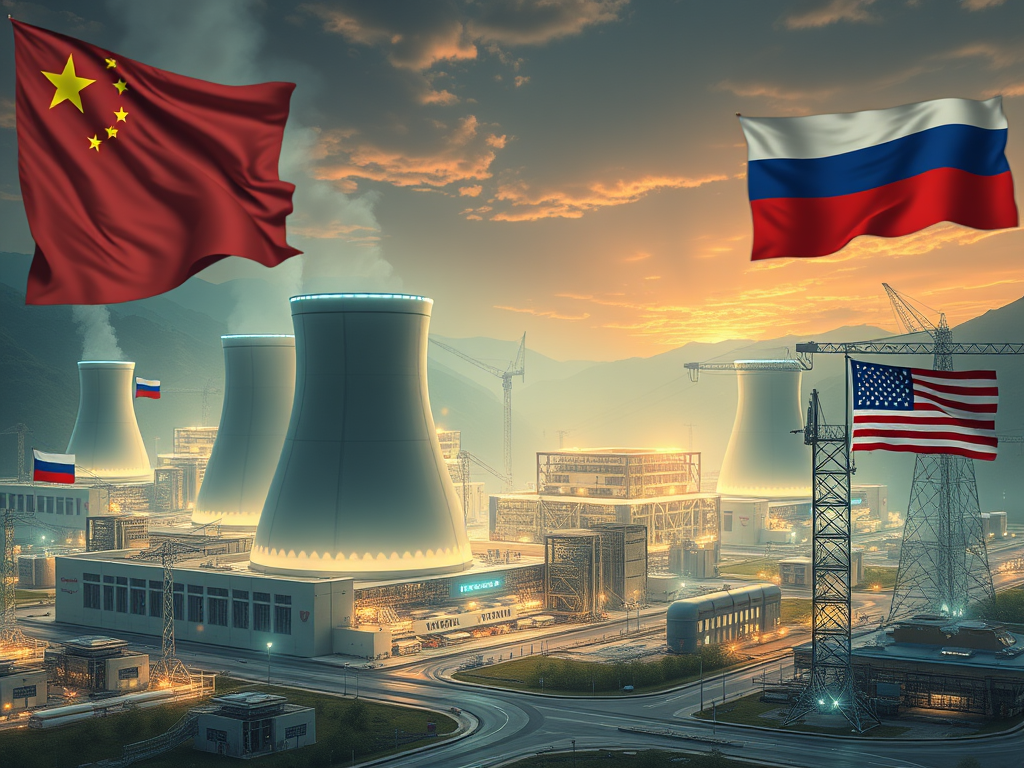
China, Russia, and the United States are all jockeying for competitive advantage as the world reconsiders nuclear power amidst a resurgence of geopolitical tensions and growing demand for electricity.[2] From an American perspective, an important question arises: is it time for an Atoms for Peace 2.0? Providing energy abundance can confer long-term geostrategic advantage. [3] But decision-making time is short because the U.S. presently trails its civil nuclear competitors.
China and Russia presently have nearly 50 gigawatts of new nuclear reactor capacity under construction—equivalent to roughly half the total capacity of the current US reactor fleet, the world’s largest (Exhibit 1). Adding other parts of Eurasia brings the total to more than 75 GW of capacity under construction, nearly 90% of the global total, according to data from Global Energy Monitor. Including projects in the pre-construction phase takes the totals even higher and reflects India’s desire to become a nuclear powerhouse as well.
Exhibit 1: The Global Nuclear Aspirations Map

Source: GADM, Global Energy Monitor, Author’s Analysis
The map and the data underlying it raise several important issues. First, the key nuclear power aspirants are (1) large energy consumers, (2) continue to experience robust energy demand growth, and/or (3) are highly concerned about the reality that “energy security = national security.” Examples include China, India, Russia, and the U.S. among the largest energy users, and Poland and the UK among middle powers.
The global potential market for nuclear power growth is enormous. Power grids worldwide crave dispatchable power yet at present, nuclear power only meets a small fraction of power demand growth. Net changes in global nuclear generation capacity are provided in Exhibit 2.[4]
Exhibit 2: Global Nuclear Generation Capacity Changes, MW/Year

Source: Global Energy Monitor, World Nuclear Association, Author’s Analysis
Scaling Up By Scaling Down?
One of the biggest questions concerns reactor size. The first reactors deployed to generate electricity in the 1950s were small by present standards but as economies of scale became important, the world moved toward the gigawatt-class units that dominate today’s nuclear landscape. How might the global buildout evolve in this new nuclear era? How will developers strike a balance between economies of scale (meaning large reactors) and desire to reduce project risk (and potentially serve more distributed demand sources) with smaller projects?
Small modular reactors (SMRs) and microreactors typically generate 300 MW or less of electricity and are likely to open additional market opportunities. Any location currently hosting utility-scale coal or gas-fired power plants could conceivably host these smaller reactors in the future and thus tie into existing transmission lines.[5] Industrial facilities, data centers, and desalination plants are also candidates where large reactors may be too big and costly.[6]
Multiple countries, including in Africa and Southeast Asia, are candidate markets for nuclear energy to alleviate energy and water poverty and power industrial and digital infrastructure expansion.[7] At present, nuclear generation supply is likely a bigger challenge than demand because the only manufacturer globally that is actively building commercial reactors for nuclear projects less than 1,000 MW in size outside its own borders is a Russian company, Rosatom.
In an uncertain geopolitical environment with renewed Great Power competition, national leaderships likely fear making a nuclear energy alignment decision that damages their broader relationships with China and the U.S. Countries seeking large-scale reactors have more options given that Korea (APR1400), the U.S. (APR1000), and China (Hualong HPR1000) can at least in theory be exported. But all the large reactor options still bring technical and economic risks that smaller countries will likely be keen to avoid.[8]
The Drive to Deploy
Russia and China thus far lead the new SMR era as the only countries that have deployed grid-connected nuclear reactors smaller than 300 Mwe in recent years (Exhibit 3). Rosatom brought its barge-based twin 32 MW (electricity) KLT-40S pressurized water reactors into commercial service in May 2020.[9] The reactor barge, named Akademik Lomonosov after a prominent 18th century Russian scientist, has now supplied power and heat to the Arctic city of Pevek for 5 years.[10]
Rosatom is also building 2 additional floating nuclear plants slated to come online in 2026 and power the Baimskaya copper mine under development along the Arctic Coast west of Pevek.[11] For its part, China Huaneng Group brought its 150 MW HTR-PM high temperature gas-cooled reactor into commercial operation in December 2023 and is on track to connect the 125 MW Linglong-1 reactor to the grid in 2025.[12] Russia’s floating SMR power plants could potentially foreshadow similar deployments at China’s remote military bases in the South China Sea, which need reliable energy supplies to operate radars and sensors, desalinate water, and potentially, one day power directed energy weapons.[13]
Exhibit 3: Global Selected SMR Deployment Timeline, 1957-2037
Red -Shaded Years = Actual Operation, Green-Shaded = Future Operation. Purple = U.S. experimental reactors

Sources: In Endnotes.[14]
The New Global Nuclear Map?
If President Eisenhower were to deliver the Atoms for Peace Speech today, a core line might be, “the capability is here—now– today—but who will achieve the scale needed to dominate production and construction?”
The Russian nuclear industrial base is already highly mobilized around a handful of existing reactor designs. Rosatom’s Podolsk manufacturing plant currently has 8 RITM-200 small, modular nuclear reactors in various stages of production for nuclear-powered icebreakers, floating power plants, and a first of its kind onshore plant in Yakutia.[15] The company has already produced 10 such reactors for existing icebreakers.
Moreover, it is now building the first of 6 RITM-200 SMR reactors slated to be sited in Uzbekistan.[16] On the higher-risk, higher innovation path, Rosatom is also building the BREST-OD-300 lead-cooled fast reactor, a 300 MWe design with a closed fuel cycle and the ability to utilize plutonium and existing reactor waste as fuel.[17] This reactor is sized on the upper end of the SMR size range.
China’s nuclear industry is also mobilized. The PRC does not yet appear to be scaling up production of a specific SMR reactor design (or designs). That said, based on the experience with the domestic Hualong One large reactor (1090 MWe, 5 reactors in service, 13 under construction, and 11 planned or approved), once the technological winners are chosen, rapid scaling will likely follow.
Once orders come in, the U.S. nuclear industrial base—which unlike China’s and Russia’s is almost entirely privately owned—should also be able to scale up. Fuel for many of the designs is likely to be a particularly important friction point, one likely to require multi billion dollar investments and 5-year time horizons even under an aggressive development pace.
Indeed, a core intent behind the Trump Administration’s recent flurry of executive orders is likely to stimulate nuclear development activities and orderbook growth that unlock multiple private dollars for each Federal dollar committed. The US Department of Energy’s Reactor and Fuel Line Pilot Programs signal a new seriousness with regards to accelerating the pace of advanced nuclear power development.[18] Henceforth, the pace and trajectory of concrete U.S. federal government actions over the next 12 months will define the development and operational environment for the next 5 years, and likely, beyond.
Russia’s nuclear business model is export led, although fallout from the Ukraine War, including sanctions on Russia, has dented Rosatom’s prospects. China and the U.S. are likely to chart a fundamentally different course, first using their massive domestic markets as nuclear power development and deployment hinterlands while secondarily serving export markets.
For countries around the world, buying nuclear reactors will be a bit like buying fighter jets: it won’t be a “cash and carry” transaction. Rather, the signing will usher in a multi-decade technological partnership. Choosing nuclear power equipment suppliers will likely coincide with (or help create) broader geopolitical and technological alignments. This dynamic unfolds now in Kazakhstan as it has chosen Rosatom to build its first large nuclear power station but immediately expressed a desire to have China build a second.[19]
Civilian nuclear exports will be an intensely contested space in coming years but one in which government policy will likely be a critical component of successfully scaling up production and use of advanced nuclear reactors. Given the strategic stakes, our research will regularly cover nuclear energy development in coming months and years.
[1] Atomic Heritage Foundation. “Eisenhower’s Atoms for Peace Speech.” National Museum of Nuclear Science & History. Accessed June 24, 2025. https://ahf.nuclearmuseum.org/ahf/key-documents/eisenhowers-atoms-peace-speech/.
[2] Gabriel Collins, “America Should Lead the Fight Against Global Energy Poverty,” Foreign Policy, 20 March 2025, https://foreignpolicy.com/2025/03/20/america-energy-poverty-china-power/
[3] Gabriel Collins, “A US-Led Energy and Food Abundance Agenda Would Reshape the Global Strategic Landscape” (Houston: Rice University’s Baker Institute for Public Policy, April 11, 2024), https://doi.org/10.25613/k0mb-7y09.
[4] Rough estimate made using change in annual global electricity generation data and assuming an average capacity utilization rate of 50% throughout the year across generating assets. Data source: https://www.energyinst.org/statistical-review/resources-and-data-downloads
[5] https://fuelcycleoptions.inl.gov/SiteAssets/SitePages/Home/C2N2022Report.pdf
[6] Gabriel Collins, “Small Modular Reactors for Nuclear Desalination and Cogeneration in the Permian Basin,” Rice University’s Baker Institute for Public Policy, May 7, 2025, https://doi.org/10.25613/M0CA-RR71.
[7] Hamna Tariq, Daniel Johansson, Todd Moss, “2025 Update: Who in Africa is Ready for Nuclear Power?,” Energy for Growth Hub, 3 June 2025, https://energyforgrowth.org/article/2025-update-who-in-africa-is-ready-for-nuclear-power/
[8] I am indebted for Brett Rampal for these points. Any errors in how they are expressed reside with me alone.
[9] World Nuclear Association. “Akademik Lomonosov 1.” World Nuclear Reactor Database. Accessed June 24, 2025. https://world-nuclear.org/nuclear-reactor-database/details/Akademik-Lomonosov-1.
[10] ГК «Росатом». “Плавучая атомная теплоэлектростанция ‘Академик Ломоносов.’” История Росатома. Accessed June 24, 2025. https://www.biblioatom.ru/core-systems/nuclear-power-plants/pates-aes.
[11] https://www.world-nuclear-news.org/Articles/Russia-commits-to-further-floating-nuclear-power-p
[12] World Nuclear Association. “Shidaowan HTR-PM 1.” World Nuclear Reactor Database. Accessed June 24, 2025. https://world-nuclear.org/nuclear-reactor-database/details/Shidaowan-HTR-PM-1.
[13] Jenner, Edward. Combating Climate Change While Promoting Nonproliferation: Addressing New Challenges. Center for Global Security Research, Lawrence Livermore National Laboratory, September 15, 2022. https://cgsr.llnl.gov/sites/cgsr/files/2024-08/SMR-FNPP-Risk_9.15.22_EJ_FINAL.pdf.
[14] U.S. Department of Energy. “Spent Nuclear Fuel, Retired Government Reactor Getting Second Life.” Office of Nuclear Energy, April 10, 2024. https://www.energy.gov/ne/articles/spent-nuclear-fuel-retired-government-reactor-getting-second-life; Kursiv Media. “How Is the Construction of the Nuclear Power Plant in Uzbekistan Progressing?” Kursiv Media, October 16, 2024. https://uz.kursiv.media/en/2024-10-16/how-is-the-construction-of-the-nuclear-power-plant-in-uzbekistan-progressing/; World Nuclear News. “Russia Starts Building Lead-Cooled Fast Reactor.” World Nuclear News, March 6, 2024. https://www.world-nuclear-news.org/Articles/Russia-starts-building-lead-cooled-fast-reactor; Nuclear Engineering International. “Ontario Approves Darlington BWRX-300 SMR.” May 20, 2024. https://www.neimagazine.com/news/ontario-approves-darlington-bwrx-300-smr/; McMurray, Jake. “Kairos Power MSR Workshop Developer Forum.” Oak Ridge National Laboratory, December 2024. https://msrworkshop.ornl.gov/wp-content/uploads/2024/12/Kairos-Power-MSR-Workshop-Developer-Forum_McMurray.pdf; U.S. Department of Energy, Office of Nuclear Energy. “Kairos Power Success Story.” Nuclear Energy University Program, July 2024. https://neup.inl.gov/content/uploads/14/2024/07/Kairos-Power-Success-Story_Final.pdf; Rosenergoatom. “Билибинская АЭС.” Accessed June 24, 2025. https://www.rosenergoatom.ru/stations_projects/sayt-bilibinskoy-aes/; Oak Ridge National Laboratory. “Molten Salt Reactor History.” Accessed June 24, 2025. https://www.ornl.gov/molten-salt-reactor/history; Nuclear Energy Institute. “Decommissioning Status for Shutdown U.S. Plants.” Accessed June 24, 2025. https://www.nei.org/resources/statistics/decommissioning-status-for-shutdown-us-plants.
[15] World Nuclear News. “Eight RITM Reactors Currently under Production.” World Nuclear News, March 12, 2025. https://www.world-nuclear-news.org/articles/eight-ritm-reactors-currently-under-production.
[16] “Для АСММ в Узбекистане отлит первый слиток.” AtomInfo.Ru, May 13, 2025. http://atominfo.ru/newsz08/a0496.htm.
[17] Dragunov, Yu. G., V. V. Lemekhov, A. V. Moiseyev, and V. S. Smirnov. Lead-Cooled Fast-Neutron Reactor (BREST): Approaches to the Closed NFC. Presented at the INPRO Dialogue Forum, IAEA Headquarters, Vienna, Austria, May 26–29, 2015. https://nucleus.iaea.org/sites/INPRO/df10/day-3/04.Lemekhov_Russia.pdf.
[18] https://www.energy.gov/ne/us-department-energy-reactor-pilot-program; https://www.energy.gov/ne/energy-department-fuel-line-pilot-program
[19] Агентство Республики Казахстан по атомной энергии. “Казахстан выбрал Росатом.” AtomInfo.Ru, June 14, 2025. http://atominfo.ru/newsz08/a0574.htm.; “Китайская CNNC станет лидером консорциума по строительству ещё одной АЭС в Казахстане.” AtomInfo.Ru, June 14, 2025. http://atominfo.ru/newsz08/a0575.htm.
Frequently asked questions
Which countries are building the most nuclear reactors?
China and Russia lead, with nearly 50 GW of new reactor capacity under construction, roughly half the capacity of the current U.S. fleet. Adding other parts of Eurasia raises the total above 75 GW, nearly 90% of global capacity under construction, according to Global Energy Monitor data. India also aims to become a nuclear powerhouse.
What are small modular reactors and where could they be used?
Small modular reactors and microreactors typically generate 300 MW or less of electricity. Sites now hosting utility-scale coal or gas plants could conceivably host them and tie into existing transmission lines. Industrial facilities, data centers, and desalination plants are also candidates where large reactors may be too big and costly.
Has any country deployed small modular reactors yet?
Yes. Russia and China are the only countries to have recently deployed grid-connected reactors under 300 MWe. Rosatom’s floating Akademik Lomonosov, with twin 32 MW KLT-40S reactors, entered service in May 2020. China’s 150 MW HTR-PM began commercial operation in December 2023, and the 125 MW Linglong-1 is on track for 2025.
Is the U.S. behind China and Russia in nuclear power?
The U.S. presently trails its civil nuclear competitors, according to Gabriel Collins. Russia’s industrial base is mobilized, with 8 RITM-200 reactors in production at Podolsk. The largely private U.S. industrial base should be able to scale once orders arrive, but fuel may require multibillion-dollar investments and 5-year time horizons.
What is Atoms for Peace 2.0?
Atoms for Peace 2.0 refers to a possible renewed U.S. effort, echoing Eisenhower’s 1953 speech, to provide energy abundance abroad for long-term geostrategic advantage. Collins argues decision time is short, and that concrete federal actions over the next 12 months will define the nuclear development environment for the next 5 years.



Leave a Reply