Download Full Presentation Here
Summary
In this April 2022 presentation, Gabriel Collins examines whether Beijing is moving toward a militarized approach to oil and gas security. Chinese decision-makers tend to treat oil disruptions as national-security problems and electricity shortages as social and economic ones, and they debate market-oriented “globalist” and mercantilist “nationalist” approaches. China’s reliance on seaborne crude persists, CNPC projects 2050 transport oil demand at roughly 2015 levels, and Collins asks what about $1 trillion in upstream spending by China’s three national oil companies has yielded. Russia’s invasion of Ukraine showed Beijing how quickly economic ties become security issues, and raised doubts about relying on a supplier that has weaponized energy for 30 years. He tracks China’s hedges, including coastal crude storage, EVs and fuel pricing, and notes that “energy security” entered China’s defense white papers in 2004, with the 2019 paper assigning the PLA to protect strategic sea lanes.
Full text of the slides (from the PDF)
Slide 1. Gabriel Collins, J.D.
Baker Botts Fellow for Energy & Environmental Regulatory Affairs
Baker Institute for Public Policy, Rice University
Please cite as: Gabriel B. Collins, “Is China Militarizing Its Oil & Gas Security Policies?” Research Presentation, 27 April 2022
Is China Militarizing Its Oil & Gas Security Policies?
*Note: These are working research findings and are subject to change. In the event of material developments, the author will post an updated version.*
Slide 2. Disclaimer & Disclosure
This analysis reflects my personal opinions and assessments only. It is designed solely to be illustrative and stimulate broader thought, with the objective of elevating the conversation in the energy and water space. It IS NOT an investment analysis or investment advice. It is also NOT offering any legal opinions or advice and does not create an attorney-client relationship with any reader or consumer of the information presented herein. Readers rely on the information in this analysis at their own risk.
Neither the author nor the Baker Institute for Public Policy are liable for any loss or damage caused by a reader’s reliance on information contained in any of the charts, data series, opinions, or other information presented herein. I am not a hydrologist, geologist, or engineer and am not offering advice on technical aspects of any assets which may be discussed in this analysis, including, but not limited to geological factors and engineering challenges that may arise in an oilfield water development project. The information and opinions contained in, and expressed by this analysis, are based on sources deemed reliable. However, there is no warranty, assurance, or guarantee, express or implied, about the completeness, reliability, or accuracy of this content. The views expressed herein are my interpretations as of the date the report is published and are subject to change without notice.
Slide 3. What Does “Energy Security” Mean in China’s Political System?
• Energy security incorporates three core concepts: (1) adequacy and diversity of supply, (2) stability of price, and (3) maintaining a relatively low price
• Chinese decisionmakers are more likely to consider oil disruptions national security problems (国家安
全问题) and electricity supply issues as social/economic problems (社会经济问题)
• “Globalists” favor greater reliance on the market and accelerated energy transition efforts to reduce oil dependence while “nationalists” favor a more forward-leaning mercantilist posture to protect
China’s energy security.
• How do parastatal entities and commercial firms interface with mercantilistic energy inclinations?
Source: Bloomberg, New York Post
Slide 4. What Role Do Oil and Gas Play in China’s Energy Picture?
Source: BP Statistical Review of World Energy, Author’s Analysis
Crude Oil as Proportion of Total Primary Energy Use Natural Gas as Proportion of Total Primary Energy Use
Slide 5. Why is Oil a Subject of Special Concern?
China Self-Sufficiency, By Fossil Energy Source China Seaborne vs. Overland Oil Imports, 2006-2021 (Million tonnes)
Source: BP Statistical Review of World Energy, Author’s Analysis Source: China General Customs Administration
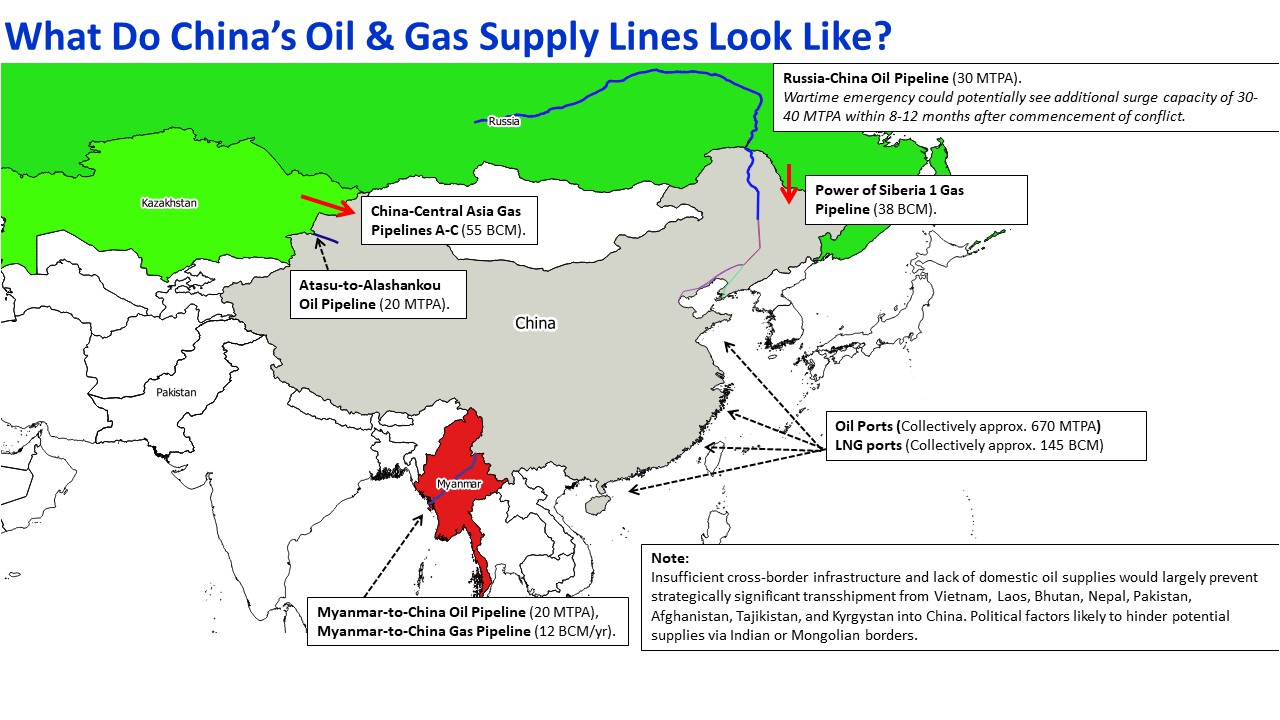
Slide 6. What Do China’s Oil & Gas Supply Lines Look Like?
Slide 7. Oil Security Pressures Unlikely to Abate Soon
Transportation Oil Use, 10,000 Tonnes
2050 forecast demand much lower than 2025 peak…but basically equivalent to 2015 levels when oil security was already a pressing concern
Source: CNPC 2050 Outlook
Slide 8. China Gas Security Will Trade Against Coal, Nuclear, Storage
Technologies…And Demand Growth, Or Lack Thereof
Source: BP Statistical Review of World Energy 2021, Author’s Analysis
China Electricity Production, 1985-2020 (TWh, by Fuel) Planned Coal Plant Additions, MW
Will post-Ukraine uncertainty push more of these from “TBD” to Year X?
Source: Global Energy Monitor, Authors’ Analysis
Slide 9. China Domestic Oil & Gas Supply Challenges Also Likely to Persist
PetroChina, Sinopec, and CNOOC Combined Investment and Production, 1998-2020
Source: Bloomberg, Author’s analysis
U.S. Est. Unconventional Oil & Gas Production, 2007-May
Source: EIA, Author’s analysis
What is the molecular dividend yielded by approximately $1 trillion in nominal upstream CAPEX?
Slide 10. Ukraine Impacts on China’s
Energy Sourcing Orientation:
It’s Complicated
Slide 11. Ukraine War Impacts on PRC Energy Security Views: 1.0
• Vociferous Western response telegraphs to Beijing that when push comes to shove, economic issues can become national security issues with lightning speed
• The world changed irrevocably on February 24, 2022
• Is the world headed toward dedollarization and commoditybacked currencies?
• What is the most relevant
“collateral” in the 21 st Century?
Oil, gold, nickel—or perhaps other polar power organizing points such as technological dominance and protective institutions?
Currency Transitions A Bit Like Energy Transitions
Source: Classical Numismatic Group, Byzantium565, Khalili Collections, CoinMan62, Bank of England, U.S. Federal Reserve
These seven
“reserve” or “quasireserve) currencies cover about 2,500 years of history
Slide 12. Ukraine War Impacts on PRC Energy Security Views: 2.0
West vs. The Rest: PPP GDP, $2017, World Bank Oil Production: OECD vs. Non-OECD
Gas Production: OECD vs. Non-OECD
Source: BP Statistical Yearbook of World Energy, Author’s
Analysis
Slide 13. Ukraine War Impacts on PRC Energy Security Views: 3.0
Does China Want To Stake A Larger Proportion of Its Future Energy Security on Russia?
Which Has Weaponized Energy Supplies Against
Smaller Neighbors For 30+ Years…
…And Which Now Also Uses Energy Supplies to Politically Coerce
Its Prime Customers
Known or Probable Politically-Driven Energy Supply or Price Manipulations By Russia
Source: ENTSOG, Author’s Analysis
Source: BBC, FOI, Keith Smith, Reuters, The New York Times From 1980s until 2021, No Sustained, Market-Defying
Restrictions in Gas Flows to Western Europe.
Gabriel Collins, “Russia’s Use of the ‘Energy Strategic Response
Options if Russia Cuts Gas Supplies to Europe Weapon’ in Europe,”
Issue brief no. 07.18.17, Baker Institute for Public Policy, Houston, Texas, 2017, https://www.bakerinstitute.org/research/russias-useenergy-weapon-Europe/
Slide 14. What Is China Doing About Oil & Gas Dependency?
Slide 15. Expanding Crude Oil Storage
Source: https://storymaps.arcgis.com/stories/f330fd6ec064476585d654c348c7f0f7
Cushing currently has about 95 million bbl of net storage capacity
Coastal sites DOMINATE China’s new oil storage project landscape.
Detailed Baker Institute China Energy Map updated bi-annually can be accessed at: https://www.bakerinstitute.org/chinas-energy-infrastructure/
Slide 16. Electrifying the Vehicle Fleet
China Has Rapidly Scaled Up Sales and Production of EVs… …But Norway’s Example Shows That Displacing Material
Volumes of Diesel and Gasoline Is A Monumental Task
Source: CAAM China, Author’s Analysis Source: Statistics Norway, Author’s Analysis
Slide 17. Price Incentives For Fuel Conservation
• Chinese policymakers have already repeatedly demonstrated a willingness to robustly intervene in local vehicle markets through license plate auctions, quotas, and EV subsidies.
• Will this be translated into more aggressive fuel pricing policies, especially for gasoline?
• Diesel a less likely target given its criticality to goods transport and resultant risk of consumer inflation
• Could dis-incentive pricing of gasoline be intensified as EV proportion of passenger car fleet rises?
Wholesale Gasoline and Diesel Fuel Prices in China vs. Crude Oil Prices
Index, May 2005 =1
Source: Bloomberg, EIA, Federal Reserve Bank of St. Louis, Author’s Analysis
Slide 18. Will China Militarize Its Oil & Gas Security Policies?
• The term “energy security” first appeared in the 2004 China Defense White Paper, the same year China’s oil imports ballooned.
• The 2006 White Paper noted that concerns about energy resource security (along with multiple other non-traditional security threats) were mounting. The 2008 and 2010 White
Papers used similar language.
• The 2019 White Paper offers more nuanced views that likely more accurately reflect leadership thinking about the intersection between naval power and commerce protection, noting that with respect to China’s overseas interests “The PLA conducts vessel protection operations, maintains the security of strategic SLOCs, and carries out overseas evacuation and maritime rights protection operations.”
Oil Supply and Demand Disruptors: Probability vs. Magnitude
Slide 19. Potential Downsides of Militarized Oil & Gas Security Approach
Damage & Casualties
Embarked Missiles by PLA Navy
Warship Class By Year-End 2022
Opportunity Cost of Moving Combat Power Out of Priority Theatre
Source: U.S. Navy Source: The Diplomat, NavalTechnology.com, Wikipedia, Author’s Analysis
Slide 20. Will China Contest Control of the Global Maritime Commons?
Soviet “Out of Area” Ship Days
Source: B.W. Watson, “Red Navy At Sea: Soviet Naval Operations on the High Seas, 1956-1980,” Westview: Boulder, Colo., 1982, table 2, p. 183
Perspective: China’s continual Horn of Africa counterpiracy deployment since 2008 accumulates a bit north of 1,100 “out of area” ship days annually
Slide 21. Will Appetite For Presence Abroad Grow With Naval Capacity?
PLA Navy Major Surface Combatant Fleet Growing Rapidly …And More—and More Capable—Aircraft Carriers Loom
Slide 22. • China is likely to continue its accelerated naval modernization program, including both quantitative and qualitative improvements to its naval and air assets, as well as special operations forces. Oil and gas import security do not appear to be a core driver of these efforts, but naval, air, and special operations capabilities are fungible across theatres on relatively short notice.
• A key warning indicator of strategic intent: pursuit of access to facilities with deep draft ports and airfields plus access agreements that permit placement of munitions and execution of combat operations.
Present Outlook
Source: https://news. agu.org/files/ 2014/11/Shi pping_routes
_red_black.p ng
Slide 23. Where Could I Be Wrong?
• Dual Circulation Drives Beijing to Seek Overmatch in Indian Ocean To Protect Resource Supply Lines
• Domestic Endeavors—Such as Transport Electrification—Fail to Meaningfully Reduce Oil Demand
• Economic Reforms Fail and the PRC Economy Remains
Disproportionately Energy Intensive
• China’s Economic Growth Does Not Slow In the Manner We Believe It
Is Now
• China Achieves Breakthroughs in Unmanned Ships and Other
Technology That Enable More Cost-Effective Global Power Projection
• China Dramatically Scales Up Its Nuclear Sub Fleet—Perhaps
Leveraging Russian Defense Industry’s Coming Desperation
Slide 24. Thank You!
Questions, Comments, Praise, and Hate Mail Alike May Be Directed To: gabe.collins@rice.edu
Slide 25. Further Reading
• Gabriel B. Collins, “China’s Energy Import Dependency: Potential Impacts on Sourcing Practices, Infrastructure Decisions, and Military Posture,” testimony at hearing on “China’s Energy Plans and Practices,” U.S.-China Economic and Security Review Commission, 17 March 2022. https://www.uscc.gov/sites/default/files/2022-03/Gabriel_Collins_Testimony.pdf
• Andrew S. Erickson and Gabriel Collins, “Competition with China Can Save the Planet: Pressure, Not Partnership, Will Spur Progress on Climate Change,” Foreign Affairs 100.3 (May/June 2021):
136–49. https://www.foreignaffairs.com/articles/united-states/2021-04-13/competition-chinacan-save-planet
• Gabriel B. Collins and Andrew S. Erickson, “China’s Climate Cooperation Smokescreen: A Roadmap for Seeing Through the Trap and Countering with Competition,” (Houston, TX: Baker
Institute for Public Policy, Rice University, 31 August 2021). https://www.bakerinstitute.org/media/files/files/0f95cafa/ces-pub-china-climate-083121.pdf
• Collins, Gabriel (2018) “A Maritime Oil Blockade Against China—Tactically Tempting but
Strategically Flawed,” Naval War College Review: Vol. 71: No. 2, Article 6. https://digitalcommons.usnwc.edu/nwc-review/vol71/iss2/6
• Andrew S. Erickson and Gabriel B. Collins, “China’s Oil Security Pipe Dream: The Reality, and Strategic Consequences, of Seaborne Imports,” Naval War College Review 63.2 (Spring 2010): 88-
111. https://digital-commons.usnwc.edu/nwc-review/vol63/iss2/8
• Collins, Gabriel B. and Murray, William S. (2008) “No Oil for the Lamps of China?,” Naval War
College Review: Vol. 61: No. 2, Article 10. https://digital-commons.usnwc.edu/nwcreview/vol61/iss2/10
–China is likely to remain heavily reliant on seaborne crude oil, and to a lesser extent , on liquefied natural gas supplies. Sustained high oil and gas prices could incrementally ameliorate the trend by incentivizing conservation, making domestic drilling more profitable, and further accelerating vehicle fleet electrification efforts. Oil and gas storage capacity in China is also likely to expand substantially in coming years.
–More gas will come overland from Russia, particularly in the wake of the invasion of Ukraine and the likely subsequent move by European consumers to reduce imports of Russia-origin gas.
–China will generally seek to maximize benefits while minimizing costs, which means a default path of continuing to rely substantially on U.S. control of the global maritime commons outside of East Asia. Certain energy exporter states, particularly in the Gulf Region, seek to play the U.S. off China to maximize their strategic leverage but it remains unclear whether China would try to supplant the U.S. as the chief security guarantor and assume the many burdens that come with that status.
–A key exception to this trend would come if the U.S. decisively stepped back from the region and left a security vacuum and access to a physical infrastructure presence network constructed over several decades. A lesser, but still impactful version of this scenario could arise if U.S. partners in the Gulf continue doubting long- term U.S. commitments to their security. This dynamic may already be playing out in its early stages.
Suggested Citation: Gabriel B. Collins, “Is China Militarizing Its Oil & Gas Security Policies?” Research Presentation, 27 April 2022
Frequently asked questions
Is China militarizing its oil and gas security?
Not by default, according to Collins’ analysis. China is more likely to keep relying substantially on U.S. control of the global maritime commons outside East Asia, seeking to maximize benefits while minimizing costs. It remains unclear whether Beijing would try to supplant the U.S. as chief security guarantor and take on the burdens that come with it.
How dependent is China on seaborne oil and LNG imports?
China is likely to remain heavily reliant on seaborne crude oil and, to a lesser extent, on liquefied natural gas. Sustained high prices could ease the trend incrementally by encouraging conservation, making domestic drilling more profitable, and accelerating vehicle fleet electrification. Oil and gas storage capacity in China is also likely to expand substantially in coming years.
Will China import more Russian gas after the invasion of Ukraine?
Yes, more Russian gas is expected to reach China overland in the wake of the invasion of Ukraine. The analysis links this shift to the likely move by European consumers to reduce imports of Russia-origin gas. Overland pipeline supply adds to, rather than replaces, China’s heavy reliance on seaborne crude oil and liquefied natural gas.
What could push China to take a bigger security role in the Gulf?
The main trigger would be a decisive U.S. step back from the region that leaves a security vacuum and access to a physical infrastructure network built over several decades. A lesser but still impactful version could arise if U.S. partners in the Gulf keep doubting long-term U.S. security commitments, a dynamic that may already be emerging.

Leave a Reply