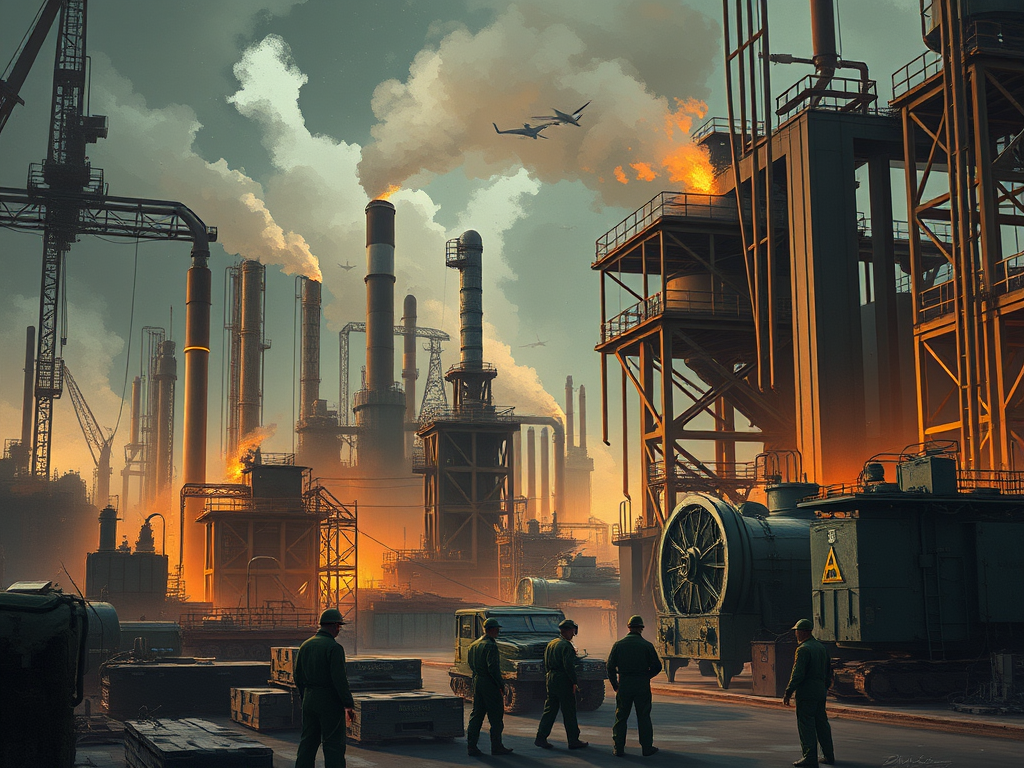
Winning the Great Power industrial competition requires a crowd, not a king.
China produces nearly one-third of the world’s manufacturing output. That shapes the world in ways unfavorable to allied reindustrialization. And if war breaks out in Asia, that advantage becomes a weapon.
During World War II, the United States was THE Arsenal of Democracy. In the modern era, it should strive to be AN Arsenal of Democracy. It will be a foundational one, as it is larger than any of our allies and partners. But it cannot be the only one.
The present industrial competition will greatly shape the strategic environment, deciding prosperity today and power tomorrow. Power and perceptions of power will in turn either convey a message of deterrence if allied industrial re-animation succeeds or else invite war if it fails. The history of warfare between industrial nations counsels that the short sharp wars planners from Napoleon to Schlieffen to Putin dreamed of are rare.
The nearly 4 years (and running) of brutal fighting in Ukraine reminds us that war is more often a contest of societal and industrial endurance. Wars are won when resilient societies take smart human strategy and translate it into scalable attacks delivered by machines. In World War II, planes, ships, and tanks poured out of Detroit. In Ukraine, it is a mix of shells, missiles, and drones pouring from workshops and factories alike. But in both cases, the commonality is that industrial capability equals national security.
Capability is needed to win wars, and in the most ideal cases, it helps deter them. China craves a short sharp conquest of Taiwan—not a multi-year war of attrition. An industrial base capable of delivering the latter helps Xi Jinping wake up each morning and think “today is not the day.” Each day that happens is a win for the world.
Back to the Competition With China
There is only one viable near-term path to avoid being overwhelmed by China’s industrial juggernaut: collaboration between allies and trusted partners. The annual manufacturing value added production of the Axis of Autocracy—led by China—is nearly $5 trillion current dollars (Exhibit 1).
Exhibit 1: Global Manufacturing Value-Added, By Geopolitical Grouping

Source: World Bank, US BEA, Author’s Analysis
The US and its most trusted allies and partners collectively produce about 10% more than this in real terms. In PPP terms, China’s production would be significantly larger. A stark strategic reality thus emerges: compete together or be picked off and subjugated separately.
The non-China grouping does not need to outproduce China on a one-to-one basis. But it needs to expand while remaining optimized, so as to squeeze more impact out of each unit of capital investment made into industrial activity. It will also need to consider multi-lateral actions to restrict Chinese-made goods and further strand Chinese industrial investment and reduce PRC returns on capital.
One approach would be the US ceasing economic friendly fire and instead coordinating tariffs on China with allies. Do this long enough and tightly enough and it can open more competitive space for non-PRC manufacturing.
Manufacturing is part of a broader competitive strategy that requires international cooperation to succeed. It’s a tall order in today’s world but one worth pursuing. Over much of the past year, the US manufacturing investment trendline has gone downwards (Exhibit 2).
To get it back on the right track will require both domestic capital contributions and injections of capital, technology, and talented people from abroad. It will also require serious consideration of the tradeoffs between the current relatively strong dollar (which attracts capital) and a weaker dollar that would make exports more competitive and blunt China’s PPP edge.
Exhibit 2: US Manufacturing Fixed Investment, Quarterly, Million 3Q2025$

Source: US BEA, Author’s Analysis
Life on The Bleeding Edge Requires Industrial Interdependence
Countries who build and sustain the technological frontier do so through industrial interdependence with trusted partners. There is no other way to generate ideas and mobilize the capital needed to bring them to fruition on a global scale. Sovereign capabilities matter. But no single nation can build, finance, harden, and scale the industrial ecosystem required to deter a modern industrial war—or win one if it breaks out. China may be the closest and that is indeed the pacing challenge.
Weapons of Mass Production come from a peacetime industrial fabric that delivers prosperity today, and if an enemy strikes us, a flood of lethal machines tomorrow. Industrial fortresses crack over time. Fabrics and networks are anti-fragile. They evolve, endure, and prevail.
Suggested Citation: Gabriel Collins, “The US Cannot Win a Manufacturing War Alone,” The Sinews of Civilization: Fire, Food, Water, Force, February 10, 2026, https://gabrielcollins.substack.com/p/the-us-cannot-win-a-manufacturing


Leave a Reply