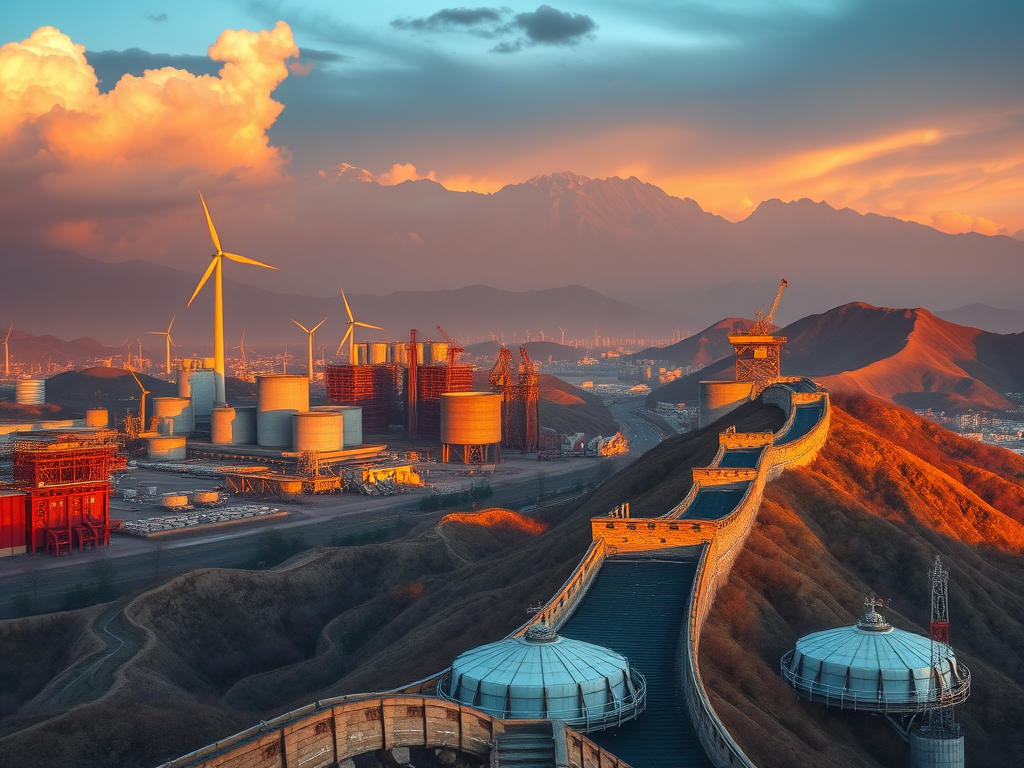
China’s response to increasing global chaos and a faster pace of events is to build an energy fortress. Coal as a foundational fuel, larger strategic stockpiles of crude oil, more overland imports of natural gas, more wind, solar, and hydro power, and more nuclear energy are all part of the equation.
Under this mindset, security and stability are the primary objectives–reductions in carbon, sulfur oxides, and other emissions are tertiary benefits. They are welcome if and when they may happen, but would be the “icing” on an energy security “cake” being baked with security as the foremost objective. Elements of autarchy, mercantilism, and some market engagement and shaping are all mixed into the enterprise. Interesting times lie ahead.
Below is a link to the full slide deck, which underpinned my panel remarks at the Baker Institute Annual Energy Summit that for 2025 covered “Resilience in Energy Supply Chains.”
Gabriel Collins, “China Builds an Energy Fortress,” 7 October 2025, Collins Research Portal, https://collinsresearchportal.com/wp-content/uploads/2025/10/Collins_China-Energy-Fortress_7-October-2025.pdf
Further Reading:
- Gabriel Collins, “Reality Is Setting In: Asian Countries To Lead Transitions in 2024 and 2025” (Houston: Rice University’s Baker Institute for Public Policy, August 22, 2024), https://doi.org/10.25613/FGC3-Y189.
2. Gabriel Collins, J.D., “Energy Stockpiling as a China Strategic Warning Indicator,” June 2024, Invited testimony to U.S.-China Economic and Security Review Commission Hearing on “China’s Stockpiling and Mobilization Measures for Competition and Conflict,” https://www.uscc.gov/sites/default/files/2024-06/Gabriel_Collins_Testimony.pdf
3. Gabriel Collins and Steven R. Miles, “Is the US Preparing to Ban Future LNG Sales to China?” (Houston: Rice University’s Baker Institute for Public Policy, April 25, 2024), https://doi.org/10.25613/TA53-BN97.
4. Gabriel Collins. “Energy as a Strategic Space for China: Words and Actions Point to a Competitive Future.” Strategic Space. The National Bureau of Asian Research, February 28, 2024. https://strategicspace.nbr.org/energy-as-a-strategic-space-for-china-words-and-actions-point-to-a-competitive-future/.
5. Collins, Gabriel and Gopal Reddy. 2022, “How China’s Water Challenges Could Lead to a Global Food and Supply Chain Crisis,” Research paper no. 11.14.22. Rice University’s Baker Institute for Public Policy, Houston, Texas. https://doi.org/10.25613/526F-MR68.
6. Gabriel B. Collins, “China’s Energy Import Dependency: Potential Impacts on Sourcing Practices, Infrastructure Decisions, and Military Posture,” testimony before the U.S.-China Economic and Security Review Commission, hearing on “China’s Energy Plans and Practices,” March 17, 2022, https://www.uscc.gov/sites/default/files/2022-03/Gabriel_Collins_Testimony.pdf.
7. Gabriel Collins and Andrew S. Erickson. China’s Climate Cooperation Smokescreen: A Roadmap for Seeing Through the Trap and Countering With Competition. Houston, TX: Rice University’s Baker Institute for Public Policy, August 31, 2021. https://www.bakerinstitute.org/research/chinas-climate-cooperation-smokescreen
8. Collins, Gabriel. 2020. China’s Debt Bubble and Demographic Stagnation Pose Major Risks to Global Oil Prices— and U.S. Shale Prospects. Issue brief no. 08.13.20. Rice University’s Baker Institute for Public Policy, Houston, Texas. https://www.bakerinstitute.org/research/chinas-debt-bubble-and-demographic-stagnation-pose-major-risks-to-global-oil-pricesand-us-shale-pros


Leave a Reply