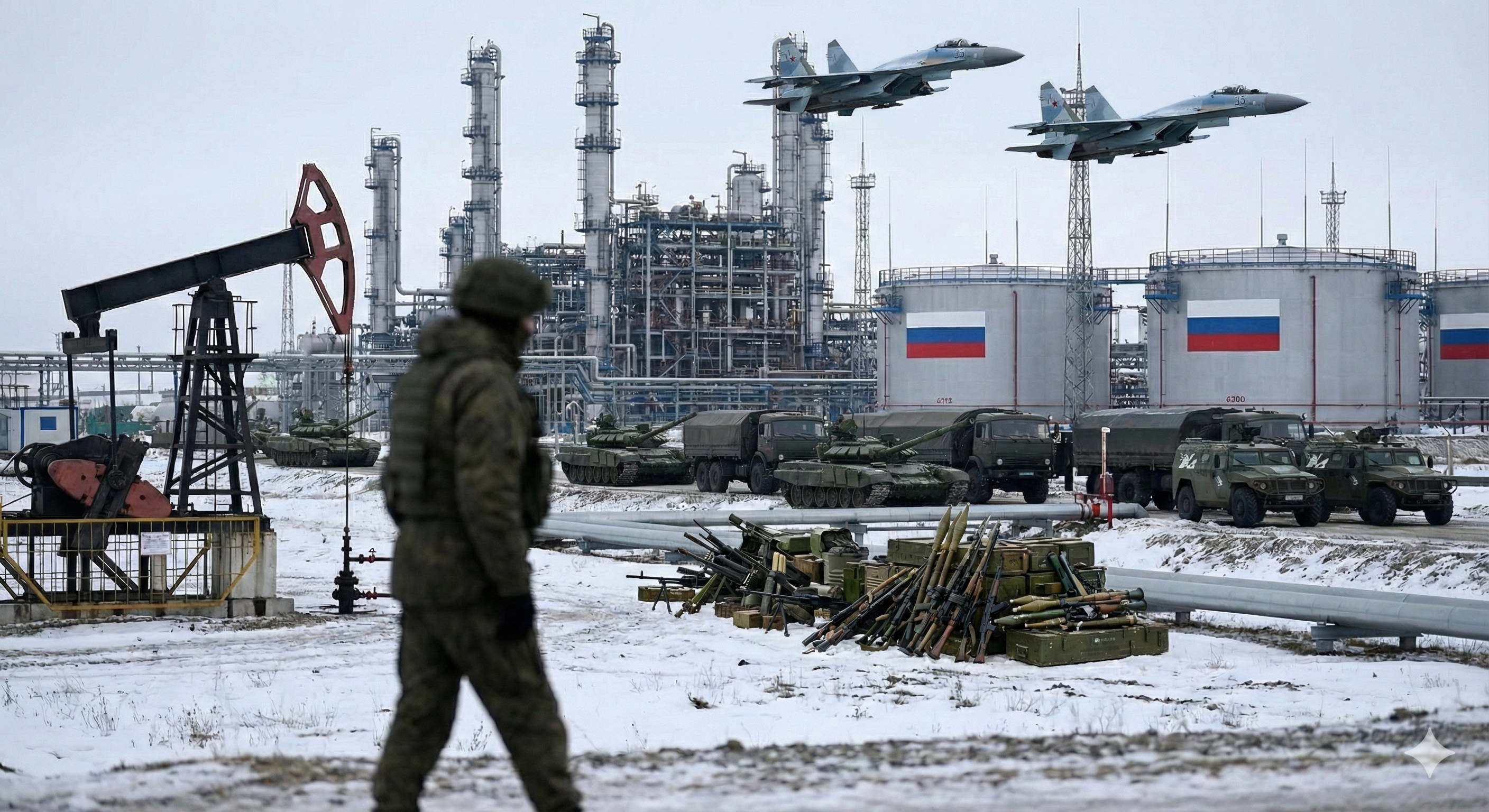
As Ukraine’s DeepStrike operations continue, it’s worth thinking about the economic costs the strikes are likely imposing on Russia. Accordingly, this analysis quantifies the economic pressure imposed on the Russian Federation by Ukraine’s DeepStrike campaign.
By modeling the correlation between likely war expenses and oil export volumes, I estimate the volume of oil likely required to sustain the current war effort at a given oil price level. This is a “Version 1.0” beta model that I will update as I learn more.
Top-Line Estimates
- Daily Cost of War: The model estimates Russia’s direct daily war expenditure is currently $190 million to $200 million.
- The “Solvency” Threshold: To fully fund this expenditure through current revenue streams, Russia must export approximately 4.0 million barrels per day (bpd).
- Strategic Implication: DeepStrike operations that reduce oil export capacity below the 4.0M bpd threshold significantly complicate the Kremlin’s financial ability to sustain its war effort.
Core Model Assumptions
The “Barrels & Bombs” beta model relies on the following baseline inputs:
| Variable | Assumption | Notes |
| Realized Oil Price | $55 / bbl | Based on current Urals prices, assumes low effectiveness of price cap |
| Net Profit Margin | 35% | Calculated net of extraction, transport, and tax costs. |
| Budget Reliance | 40% | The portion of the Russian Federal Budget derived from oil revenues |
Methodology Note: The “Barrels & Bombs” Balance Sheet
Goal: To calculate the direct operational daily “burn rate” of the Russian war machine. This model moves beyond broad estimates by itemizing costs across 12 specific combat vectors, sourced from open-source intelligence and market data.
Top-Line Estimate: ~$195 Million per day To fund a single day of fighting, Russia must export ~4 million barrels of oil (assuming $55/bbl realized price).
Our model aggregates costs into three primary “Cash-Flow Buckets.”
1. Personnel: The Dominant Cost Driver (~50%)
- Daily Cost: $97 Million
- The Data: Based on analysis from Re-Russia.net (July 2024), payouts to soldiers (salaries, combat bonuses, and injury/death gratuities) have reached approx. 1.5% of Russia’s GDP.
- Strategic Note: This is the “sticky” cost of the war. Unlike munitions, which can be rationed, personnel costs are fixed or rising. The model estimates this requires 2.0 million bpd of oil exports just to cover the human payroll.
2. The “Long-Range Strike” Complex
- Daily Cost: ~$37 Million
- Breakdown:
- Heavy Missiles (Iskander/Kinzhal): $18M/day (Avg. 7 units fired).
- Long-Range Drones (Shahed/Geran): $12M/day (Avg. 165 units).
- Glide Bombs (KABs): $4M/day (Avg. 150 units).
- Kamikaze Drones (FPV/Lancet): $3M/day (Avg. 6,000 units).
- Insight: While “cheap” drones are often highlighted, the sheer volume of usage (6,000/day) and the continued reliance on expensive heavy missiles ($2.5M unit cost) keep this bill high.
3. Ground & Air Force Attrition
- Daily Cost: ~$56 Million
- The “Artillery Tax”: Surprisingly, the highest hardware cost is not tanks, but Artillery.
- Shells: $20M/day (20,000 rounds @ ~$1,000/shell).
- Guns/Systems: $23M/day (loss of ~15 units/day @ $1.5M avg).
- Vehicle Losses:
- Tanks: $3M/day (Conservative baseline of 2 losses/day).
- IFVs/AFVs: $9M/day.
- Jet Operations: $5M/day (150 flight hours).
Data Provenance & Sources
To ensure transparency, this beta model utilizes unit costs and usage rates derived from the following primary sources:
| Category | Source Authority | Key Metric Used |
| Personnel | Re-Russia.net | 1.5% GDP estimate for soldier payouts |
| Shell Production | The Kyiv Independent | 3x production rate vs. West ($1k/shell) |
| Missiles | United24 Media | $2.5M weighted avg for heavy strikes |
| Maintenance | US Gov Accountability Office (GAO) | Aircraft sustainment benchmarks |
| Unit Costs | The War Zone / Fivecoat Consulting | Replacement values for Tanks/IFVs |

Sensitivity Analysis: The “Asymmetric Impact” Hypothesis
A key variable is the ratio of global oil price changes versus crude oil export volumes lost due to Ukrainian strikes.
The Thesis: If the global oil market remains well-supplied and strikes do not cause major global price spikes, Ukraine has strong incentives to strike Russian export facilities. Even if oil prices rise, they will likely rise at a lower rate than the volumes Russia loses. That is attritional balance Ukrainian decisionmakers would find extremely attractive.
Case Study: The Novorossiysk Divergence
- Event: During the November attack on Novorossiysk, Russia temporarily lost roughly 25% of its oil export capacity.
- Market Reaction: Global oil prices rose by only 2%.
- Conclusion: If this ratio (25% volume loss vs. 2% price increase) endures during future strikes on crude export facilities, it would prove Ukraine can degrade Russian earnings without triggering the oil price driven inflation and consumer burdens that Western allies fear.
Direct Costs of Infrastructure Damage
Beyond export revenue, strikes on refineries impose significant repair and friction costs.
To quantify this, I compiled a comparative dataset of industrial accidents at U.S. and German refineries over the past 20 years (sourced from the U.S. Chemical Safety Board and corporate filings). The data suggests that even non-catastrophic explosion events typically incur $30-to-$50 million in direct damage per incident.
Relevant Comparables:
- BP Texas City Explosion: CSB Investigation Report
- Martinez Refinery Incident: PBF Energy Updates
- Valero Refinery Status: CSB Safety Recommendation
While Russian operators have shown resilience by utilizing spare capacity and executing rapid repairs, these costs are cumulative. The DeepStrike campaign should be viewed not as a “knockout blow,” but as a compounding attritional tax on the Russian war economy.


Leave a Reply