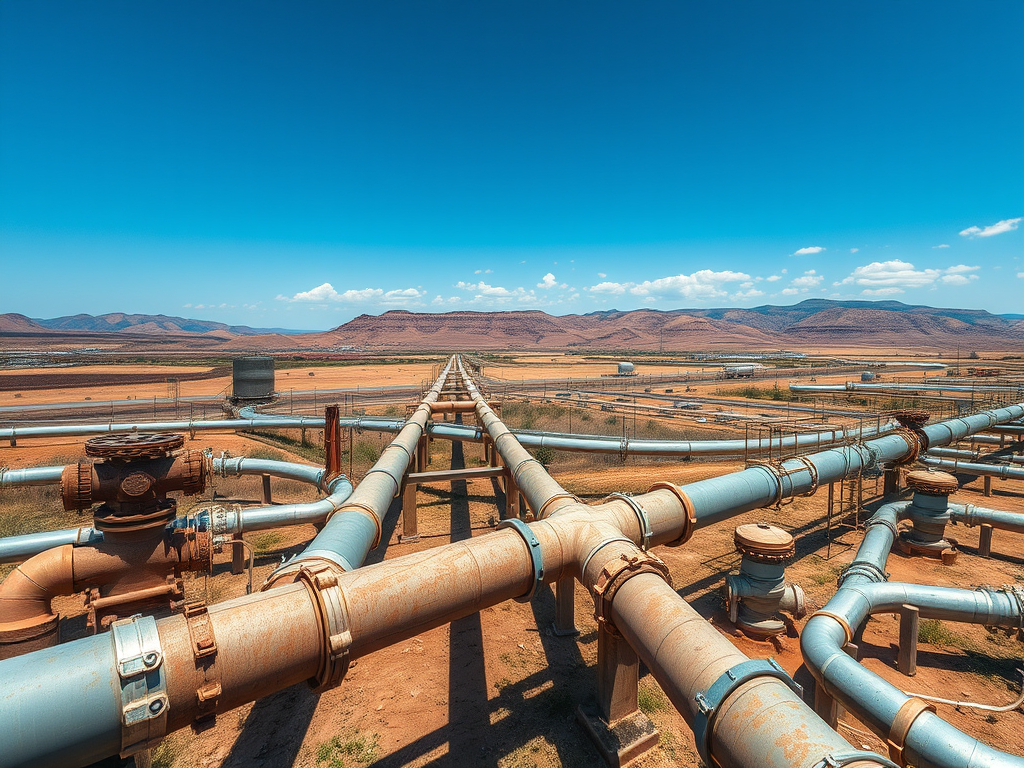
The document discusses the challenges and costs associated with the proposed Cross Texas Water Grid, highlighting historical context, infrastructure needs, and potential economic impacts on Texas water supply.
Please cite as: Gabriel Collins, “Cross Texas Water Grid: Key Challenges and Economic Costs,” Collins Research Portal, 24 April 2025. https://collinsresearchportal.com/wp-content/uploads/2025/05/The-Cross-Texas-Water-Grid_-Key-Challenges-Costs-3.pdf
Slide deck downloadable here.

Historical Context of Water Infrastructure
President Lyndon B. Johnson emphasized the importance of water as a vital resource during the signing of the Colorado River Basin Project Act in 1968. The Central Arizona Project aimed to deliver significant water supplies to Arizona, serving as a historical reference for Texas’s current water planning efforts.
- The Central Arizona Project is a 336-mile canal system delivering 1.6 million acre-feet/year of Colorado River water.
- The project took 12 years from construction commencement to first water delivery.
- Texas’s 1968 Water Plan proposed a much larger system, aiming to deliver nearly 10 times the water over a longer transport grid.
Current Water Infrastructure Concepts
Recent discussions in Texas reflect a renewed focus on large-scale water infrastructure projects to address potential drought impacts. The proposed Cross-Texas Water Grid faces several critical challenges that could hinder its effectiveness.
- The 1968 plan aimed to move 16 million acre-feet/year through extensive systems.
- Major Texas metro areas generate about $1 in economic activity per gallon of local water supply.
- Infrastructure investments are deemed necessary to mitigate risks associated with prolonged drought.
Challenges of Cross-Texas Water Grid
The proposed Cross-Texas Water Grid faces five significant challenges that could complicate its implementation and effectiveness. These challenges include distance, elevation, electricity demand, interbasin transfer rules, and cost.
- Distance & Elevation: Water must be pumped uphill, with elevations reaching 2,400 to 3,000 feet, complicating transport.
- Electricity Demand: The grid could become Texas’s largest power user, requiring an estimated 6.9 gigawatts of electricity.
- Interbasin Transfer Rules: Current regulations make transferring water between basins difficult, potentially disadvantaging junior rights holders.
- Demand Growth Areas: The grid’s focus may not align with areas of highest future water demand.
- Cost: Water from a 600-mile pipeline could cost approximately $4,000 per acre-foot, making it the most expensive bulk water in Texas.
Economic Implications of Water Supply
The economic activity generated by water supply in Texas is significant, with potential for substantial growth if water infrastructure is improved. The cost of water is rising, impacting cities’ ability to secure affordable water sources.
- Each 100,000 acre-feet of incremental water supply can support over $30 billion in economic activity.
- Water sourcing costs are increasing, with San Antonio’s water sourcing price trends indicating rising expenses.
- Cities may need to shift from low-cost water rights to more expensive alternatives like desalination due to prolonged drought.
Historical Success Despite Water Plan Shelving
Despite the shelving of the 1968 Water Plan, Texas has thrived economically through improved water use and efficiency. Various strategies have contributed to the state’s success in managing water resources.
- Texas industrialized and improved water efficiency, leading to better water use.
- Farmers adapted by switching crops and enhancing irrigation practices.
- The marketization of water allocation in regions like the Edwards Aquifer has improved resource management.
Alternative Approaches to Water Management
Regionalized water grids and enhanced water recycling present viable alternatives to the Cross-Texas Water Grid. These strategies could leverage existing infrastructure and promote sustainable water use.
- Regional water infrastructure densification could be combined with drought-resistant supplies like desalination.
- Successful examples from El Paso and San Antonio demonstrate the potential of desalination to meet water needs.
- Marketization of water resources can drive innovation and efficiency, encouraging infrastructure development.




Leave a Reply